

 Login
Login
 Cart
Cart
Same-day delivery (SDD) is no longer a pleasing logistical benefit in the electrifying arena of the eCommerce ecosystem of 2025: it is the heartbeat of consumer satisfaction, a hyper-speedy service that is the combination of an instant business with a hyper-predicting algorithm of fulfillment to deliver packages within hours after the order has been placed. With sales in eCommerce passing worldwide to a point of 8.1 trillion, SDD has its market value measuring at 14.7 billion, with a 20.8% CAGR expected to grow between 2023, due to AI-coordinated route optimization and micro-fulfillment centers. But this customer-tornado transforms customer psyches into an inescapable demand for less-than-six-hour turnarounds, placing retailers in a vortex of business tempests between the scalability of the gig economy and the issue of carbon footprints.
Imagine the following future setting: A Gen Z customer browsing urban sprawl, scrolling their TikTok Shop with their thumb, impulse-buys a sustainable athleisure outfit, and, before sunset, the drone will deliver the purchase, also AR previews showcase how the product would fit over their skin in real time, which relies on data consent of zero-party. This is not hype; 8 out of 10 consumers now require SDD, 49% consider SDD a deal-maker to online carts, compared to only 2% of 2018 who equated fast shipping to same-day. The 2025 consumer pulse done by McKinsey shows that 90% of entrants will only tolerate wait times of 2-3 days on the condition that fees are eliminated, but half of 18-34-year-olds demand SDD as a table stake, that is, a blend of immediacy and integration. It is the two-sided sword; SDD raises the bar of loyalty by 30% with frictionless trips, at the expense of the back-end infrastructure of last-mile logistics, which had gobbled 53% of the cost of fulfillment in cities and supply volatility.
This essay, part of a 2500-word treatise, disembowels the seismic changes in SDD, inexplicably interlacing the words of the future, 2025, with the prospects of future 2030 of drone-swarm symphonies and neural-forecasted inventories. To retailers, it is a wake-up call: Use AI-based predictive analytics to surpass expectations or risk being victim to cart abandonment in the expectation economy. Let us unstuff the goldsmith’s alchemy, the furnace of anarchy.
The Surge of Same-Day Delivery: A Market Metamorphosis
The SDD rise can be traced to the post-pandemic velocity addiction, in which lockdowns rocketed eCommerce to 16per cent to 24per cent of the world’s retail by 2025, according to the Statista barometer. An example of this is the Buy with Prime extension of Amazon Prime, which now covers 40% of DTC brands: Prime Day 2025 has made 24.1 billion, and the ratio of SDD conversions reached 37% through biometric smooth checkouts and geo-fenced prompts. 80% of consumers now expect retailers to offer SDD; of these, 76% want items within three hours. In the world market, North America has already occupied 38.6% of the market share with the support of micro-centers of Walmart and the presence of grocery blitzes of DoorDash, and Asia-Pacific has already reached 52% market share in eCommerce through the urban air mobility pilot, which is led by Alibaba Cainiao.
There are technological enablers in the predictive demand sensing functionality of AI, such as FreightAmigo’s ability to use neural nets to detect demand, which reduces fulfillment latency by 45 percent, allowing for so-called ghost stocking: pre-positioned inventories at edge warehouses. Gig websites such as Uber Eats are being used to combine with enterprise logistics, recruiting 70% more couriers in peak surge, and blockchain provenance assurances to ethical sourcing are persuading 65% of eco-conscious millennials. However, this boom has bifurcations: B2C reaches $6 billion, B2B is only at $2.2 billion with just-in-time (JIT) requirements, and C2C is even more successful at the $1.4 billion that requires hyperlocal delivery like Depop.
SDD is showing a golden glow in terms of economic performance: Retailers who implemented it report that an average order value (AOV) has increased by 28 percent, as one-click velocity prevents abandonment. 48% of carts are abandoned when shipping times take more than 2 days, and 46% of shoppers are willing to pay extra for premium same-day delivery options. Sustainability checks in: The 2025 E-Commerce Trends Report by DHL mentions the term green last-mile as one of the measures of loyalty (76 percent of surveyed prefer going carbon-neutral), which has led to the rise of electric van groups and bike-courier teams. Within the real-time chorus of X, users like @deliv_AI promote SDD as a customer acquisition alchemy, embedding ad-reach micros in delivery to transform logistics into revenue streams. This transformation does not last long; it represents the new e-comm ethos, where speed becomes stickiness.
Elevating Customer Expectations: From Novelty to Imperative
SDD has adjusted the thermostat of expectations to a new level and has transformed from a luxury into a baseline in the frictionless frontier. The survey conducted by Capital One Shopping indicates that 41% of its clients pay pony up prices on SDD, 23% desire 3-hour blitzes, and 72% belong to the premium free shipping-SDD velvet rope level. Generational differences become even stronger: 56% of 18-34-year-olds consider SDD a non-negotiable point, according to Invesp. Meanwhile, 30% of all are ready to receive free versions, highlighting the concept of the so-called generational velocity difference. The proprietary McKinsey poll of 1,000+ U.S. consumers sheds light on the Fact That on-Time Delivery beats speed 90% will tolerate 2-3 day delays fee-free, 50% will monitor with apps, and 85% will accept 1-2 day delays with prior notification.
This paradigm shift is realized in behavioral blueprints: 49% shift to SDD-enabled platforms, according to Elite EXTRA, swell AOV by 20% with bundled “velocity vaults” -add-ons such as express personalization. Recent surveys reveal that 49% of shoppers are more likely to purchase if same-day delivery is available, while 25% will abandon their carts entirely if it’s not, showing just how central delivery speed has become to purchase intent. Social commerce enhances: Live-stream hauls on TikTok, when connected to Shopify through its SDD APIs, increase by 28% with UGC reels as proof of velocity. Agony is still present–a third of the audience proclaims SDD a game-changer in the survey conducted by Scoop, but 15% sneer snipe, pointing to rural dead spots where geo-fencing fails. X anecdotes reverberate: @pavilion_clean offers carpet pick-up video deals with the promise of unmatched care, but @ankitkawatra11 has to complain about defective SDD sales, leading to 10-14 day refunds that undermine trust.
Beauty is agonizing: Flexible slots or redirects, as reported by Wise Systems, make Real-time ETAs via WebSocket streams cut anxiety in half. Inclusivity intersects: The adaptive SDD of neurodiverse users, such as quiet-hour drops, can be used to strengthen equity, while haptic feedback in AR applications can simulate the proximity pulses of a package. These are not fanciful hopes; they are programmed into the dopamine drip of digital natives, and brands must plan how to create delightful differences to beat off competition.
Operational Challenges: The Last-Mile Labyrinth
Beneath the gloss of SDD itself, beasts like these last-mile logistics, consuming half of the expenses, have to deal with urban entropy – traffic jams, weather vagaries, and ambiguity in addresses to swell failed attempts by 15 percent. In 2025, ClickPost projects B2C of $6B, but can’t scale: Gig couriers, essential to 70 percent coverage, burn out in surging pricing spikes, and turnover in 22 percent when there are algorithmic inequities. Inventory coordination breaks down- multi-channel operations (3 or more platforms) have twice as many errors, according to BigCommerce, since siloed ERPs are slower at real-time coordination.
The problem of costs is compounded: SDD premiums can only be used to counter 20-30 percent increases in fuel and labor, according to Bringg, and this means value-velocity arbitrage -leveled prices or subscription protection such as improved Prime levels. Reverse logistics competitors in the opposite direction: Returns 30 percent of orders for apparel require seamless recirculating through AI-sorted clearing yards, but balloon costs 15 percent, according to UPS. Sustainability hurts: SDD faces a rising carbon quotient, with 20% of shipments consolidated, prompting the EU to impose 2025 carbon taxes on fleets, demanding they electrify 40% of their capacity by the end of the decade.
Tech triage tempers: The blueprint created by Fareye identifies eight e-comm demons (22 percent of sales), cross-border bottlenecks, and data silos. Alleviated by TMS (transportation management systems) that achieve 25 percent efficiency gains. X frontline flares: Safe hands pitch: SDD promises (as exemplified by rental disaster) of @bdukes32 fall apart without strong ETAs, with the same SDDs in the background pitching safe hands as in the deficit of trust scenario as cited by @UduakBernard. Rural radii have not been brought to heel: 40% of U.S. zip codes lack viable SDD, according to Grand View, necessitating hybrid horizon models with drones and community lockers. These obstacles are not dales; they are agglomerates of sturdy operations, where AI anomaly sentinels serve as early warnings of disruption, and parity is achieved.
Table: Key Operational Challenges and Mitigation Strategies in 2025 SDD
| Challenge | Impact Metrics | Mitigation Tactics |
| Last-Mile Costs | 53% of total fulfillment | AI route optimization (e.g., Lyzer: 45% latency cut) |
| Inventory Sync Errors | 2x errors in multi-channel ops | ERP-TMS integrations (e.g., SAP-Increff) |
| Gig Workforce Scalability | 22% turnover in peaks | Predictive staffing via neural nets |
| Returns & Reverse Logistics | 30% apparel rate, +15% costs | Automated sorting hubs, blockchain proofs |
| Sustainability Mandates | 20% higher emissions | EV fleets, consolidated “green batches” |
| Rural/Geo Limitations | 40% U.S. zips are underserved | Drone pilots, locker networks |
Case Studies: Triumphs and Tumbles in the SDD Arena
Templates to follow: The example of the evolution of Amazon’s Prime Now, which is now AI-enhanced to anticipate shipping, i.e., pre-shipping based on browsing vectors, shot 2025 Prime retention up to 93 percent, but failed in the 2024 holiday rush, according to CMSWire. With the micro-fulfillment gambit that installed robo-sorters in 200+ stores, Walmart saved 18% on SDD expenses, but reached 95% on-time in urban cores; however, rural deliveries failed at 65% coverage, highlighting the dilemma of densities.
Shopee-Lazada duel: Lazada 2-hour metro drops using Cainiao are 22% higher, with AOV, using bundled 2-hour metro of “velocity perks, and Lazada struggles to cope with influxes of counterfeits, turning 25%. The micro-narratives of X are reflected in the promise of SDD guaranteed by @ , the promise of impressions by paying a premium, and the damage of festivities, with no premium handling by @AnkitVerma8899, which emphasises the premium of tactile care. These vignettes confirm: SDD alchemy requires whole body orchestration – tech, talent, and transparency – to transform trials into victories.
Technological Innovations: Bridging the Expectation-Execution Chasm
The tech tapestry of 2025 is so good: Locate2u uses its real-time trackers to anticipate 30% of delays and cut labor by 40 percent in pilots through AI, cognitively, it sets up logistics; autonomous pods (the Nuro rovers in cities) reduce staffing by 40 percent; and pilots are preempted before they can happen. The immutable manifests created by blockchain guarantee provenance, reducing disputes by 50%, according to FreightAmigo, since edge AI in wearables creates pulses in haptic ETAs. Calcurates predicts: Within the mid-decades, mega-fleet computation will be reduced by half with quantum-optimized routing through hybrids designed by IBM, and drones and bots will be able to collaborate in aerial-ground meshes through so-called swarm intelligence.
Sustainability synergies: EV requirements supported by DHL green fleets will reduce emissions by 25 percent, and its circular velocity – upcycled packaging loops – will satisfy 78 percent of eco-shoppers. Novelies such as the personalization of nudges within the VML, called AI shopper sentinels, predict churn through sentiment streams, increasing conversions by 35%. But the issue of interoperability is annoying: Legacy TMS silos still remain, and API federations are required to complete omnichannel oracles.
Future Prospects: 2030s Hyper-Velocity Horizon
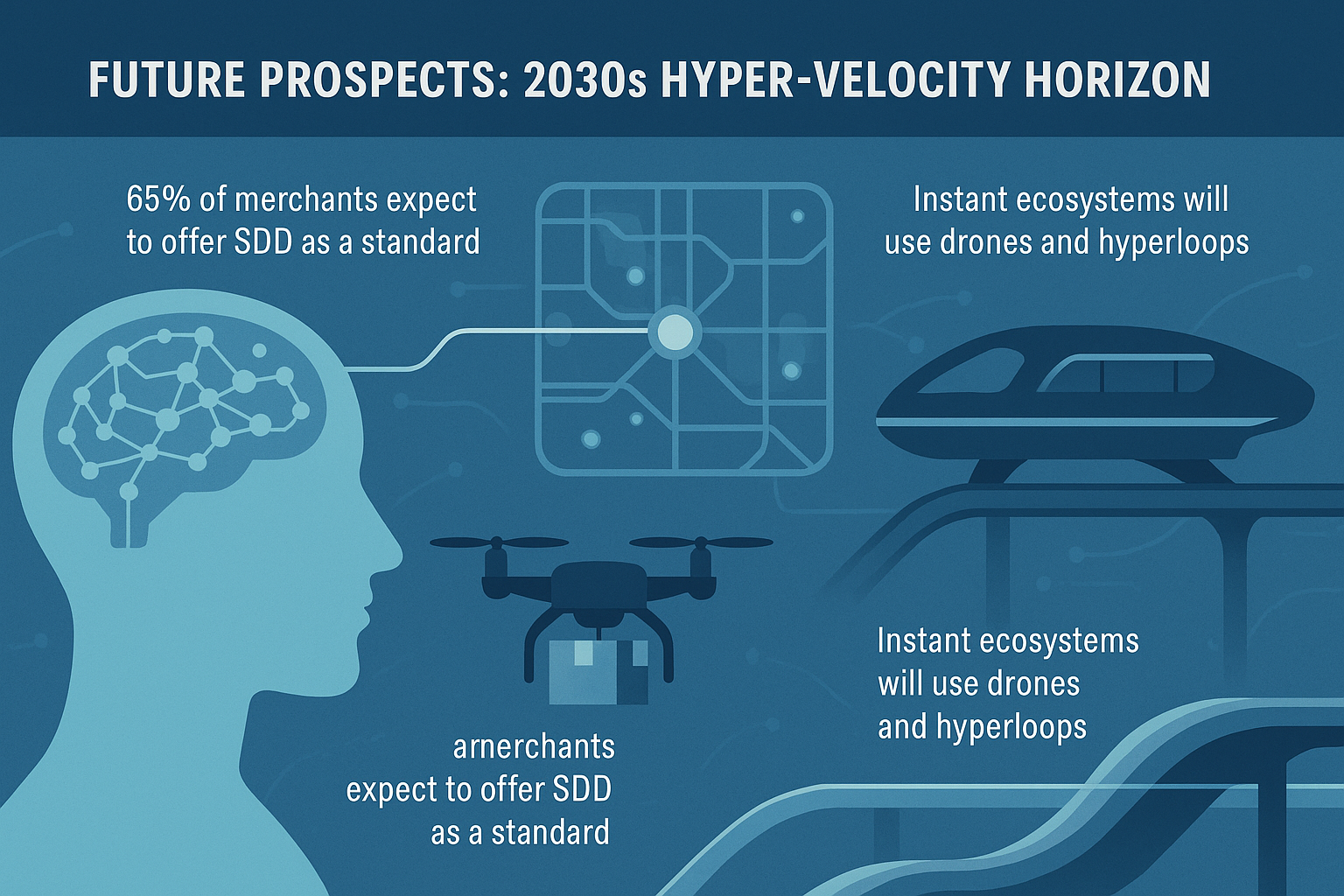
Looking at 2030, SDD evolves into the so-called instant ecosystems where neural BCIs (brain-computer interfaces) anticipate orders using thought patterns, reducing latency to minutes, as with Ericsson Sense Internet.By 2030, 65% of merchants expect to offer same-day delivery (SDD) as a standard feature, reflecting its transition from a luxury to an operational norm. Market forecasts: Opening to $36.2B by 2030 at 16.6% CAGR, with GlobeNewswire reporting that this category is dominated by the sub-categories of “aero-terrestrial hybrids”-drone swarms following hyperloops on rural radii. Hyped anticipations: 65 percent of merchants will guarantee ubiquity of SDD, and 99 percent of uptime through predictive pre-positioning using quantum forecasting.
Issues change: Geopolitical change requires resilient rhizomes, i.e., decentralizing nets using Web3 DAOs to crowdsource couriers, and carbon neutrality requires zero-emission orbits, which is offset in terms of tokenized offsets. X foreshadows: The reference to a slash of 90% RTO that advertises FleetRun to its victory over returns foreshadows the arrival of closed-loop luxuries: AR trials have to cancel regrets. Future hope: Inclusive “equity expressways” through subsidized rural bots, bringing an SDD-democratized delight to the world, combining human ingenuity with the ambient automation.
To amplify: Neural networks of neural nudges: 2030: Bio-sync offers to vitals (Oura rings that pause impulse purchases in times of stress spikes) and offering metaverse-based (i.e., virtual) vestibules (to allow pre-delivery audits). Anchors of affordability: UBI pilots will be based on dynamic equity pricing, where SDD will be subsidized on underserved swaths. Traps await–quantum cyber-threats require post-quantum cryptography to manifest, but optimism is near: Global DAOs coordinating people-powered parcels, reducing expenses by 60% through tokenized incentives.
Respecting NIQ, alpha cohorts will enforce the concept of playful provenance, i.e., gamified eco-tracks that will be rewarded with AR badges by sustainable selects. Micro-mesh in the cities through Starlink low-orbit eliminates dead zones, creating a sense of ubiquitous urgency. In a symbiotic surge, SDD would have 40 percent of the parcels by 2035 when expectations and execution mix in moral grace.
[acd_also_read]The Future of Digital Twins in eCommerce: Virtual Products, Real Sales
[/acd_also_read]
Also Read: How The Robots and Drones Delivery Could Transform Quick Commerce
Conclusion: Velocity as Virtue
The 2025 imprint of SDD, which raises the ante to the heights of imperialism and stretches operations to their limits, serves as a prelude to a renaissance where innovation sparks equilibrium. Retailers, listen to the hybrid: Artificial intelligence (AI) foresight and human compassion are creating tangible trust, transforming obstacles into competitive rockets. DHL suggests that delivery is not a destination but an empathy engine, fostering loyalty through satisfaction.
Acowebs are the developers of Woocommerce Custom Product Addons which is a optimized, lightweight, and fruitful plugin that is simply the best to add extra product options using its custom form builder easily. WooCommerce custom fields also comes with drag and drop form builder, 22+ field types and custom price formula and WordPress offload media plugin which allows you to offload your media to cloud storage such as Amazon s3, Cloudflare r3, Google Cloud, Digital Ocean and more.