








 Login
Login
 Cart
Cart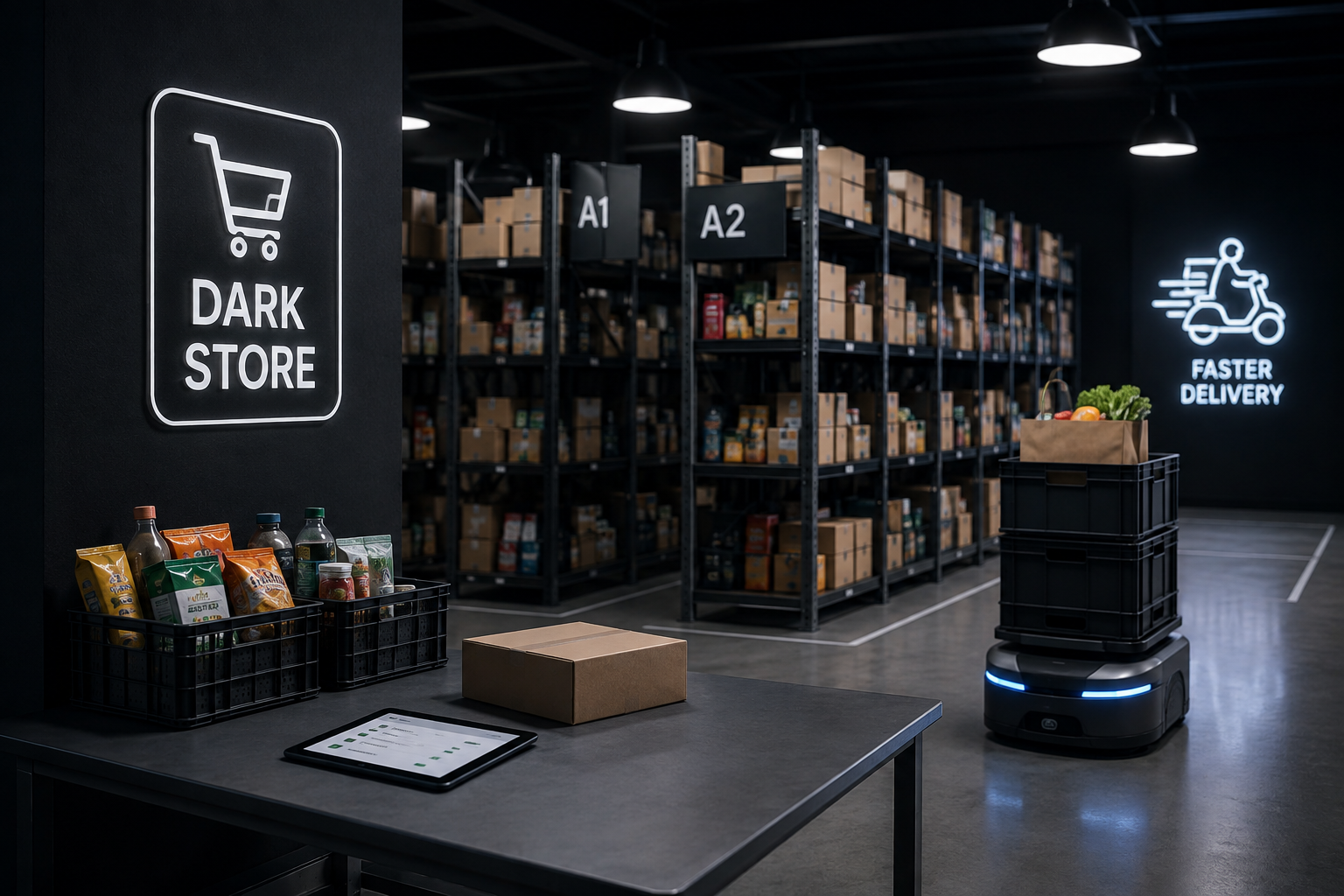
So what is a dark store? In short, it’s a physical retail location that no longer serves walk-in customers – every square foot is devoted to picking, packing, and dispatching online orders. The “dark” part refers to a storefront that never opens to the public: the lights stay on inside, but there are no shoppers browsing, no checkout counters, and no window displays.
The model isn’t new. UK retailer Tesco opened two customer-less locations back in 2009 purely to fulfill local online grocery orders, and the idea spread through the pandemic as retailers such as Whole Foods Market and Walmart began converting or building fulfilment-only spaces. A market analysis cited by Shopify estimates the global dark store market will exceed $129 billion by 2030.
How Dark Stores Work
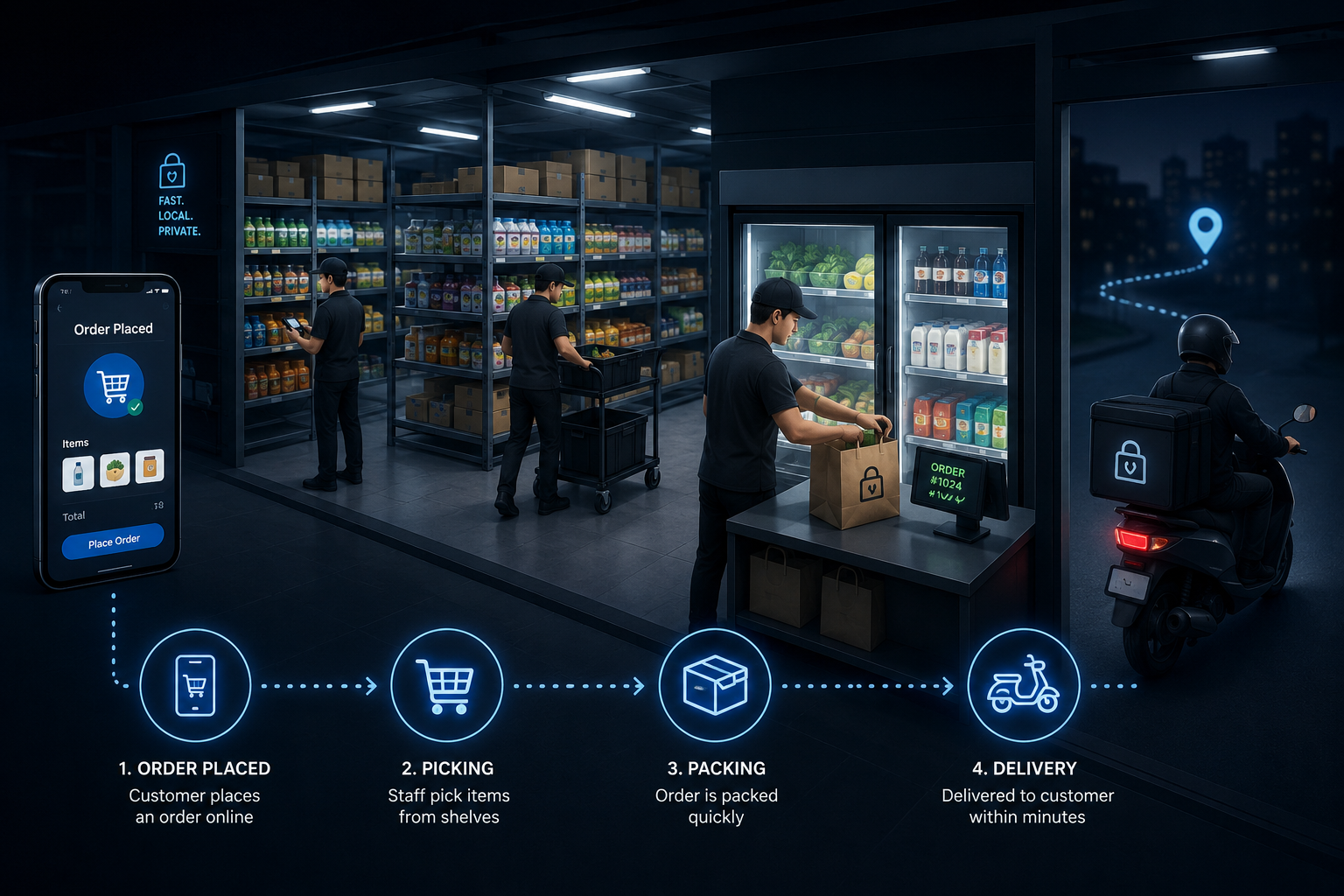
A dark store runs on a simple, repeatable order flow that mirrors standard ecommerce fulfillment – just condensed into a compact local space:
- Receive. An order comes in from a website, app, or online marketplace.
- Pick. A picker (human or robot) walks the aisles, grabs the right items, and verifies quantities. Stock is arranged for speed popular items near the front, complementary products clustered together.
- Pack. The order is packaged with special handling for temperature-sensitive goods (insulated bags for groceries, for example).
- Dispatch. The order goes out for home delivery or sits in a pickup area for collection.
Most dark stores offer two fulfillment routes. Home delivery sends orders straight to the customer’s door, often within hours for quick-commerce operators. Click-and-collect lets customers order online and retrieve the order from a pickup point or curbside bay, without ever entering a shopping floor.
Dark Store vs Traditional Store vs Warehouse vs Micro-Fulfillment Center
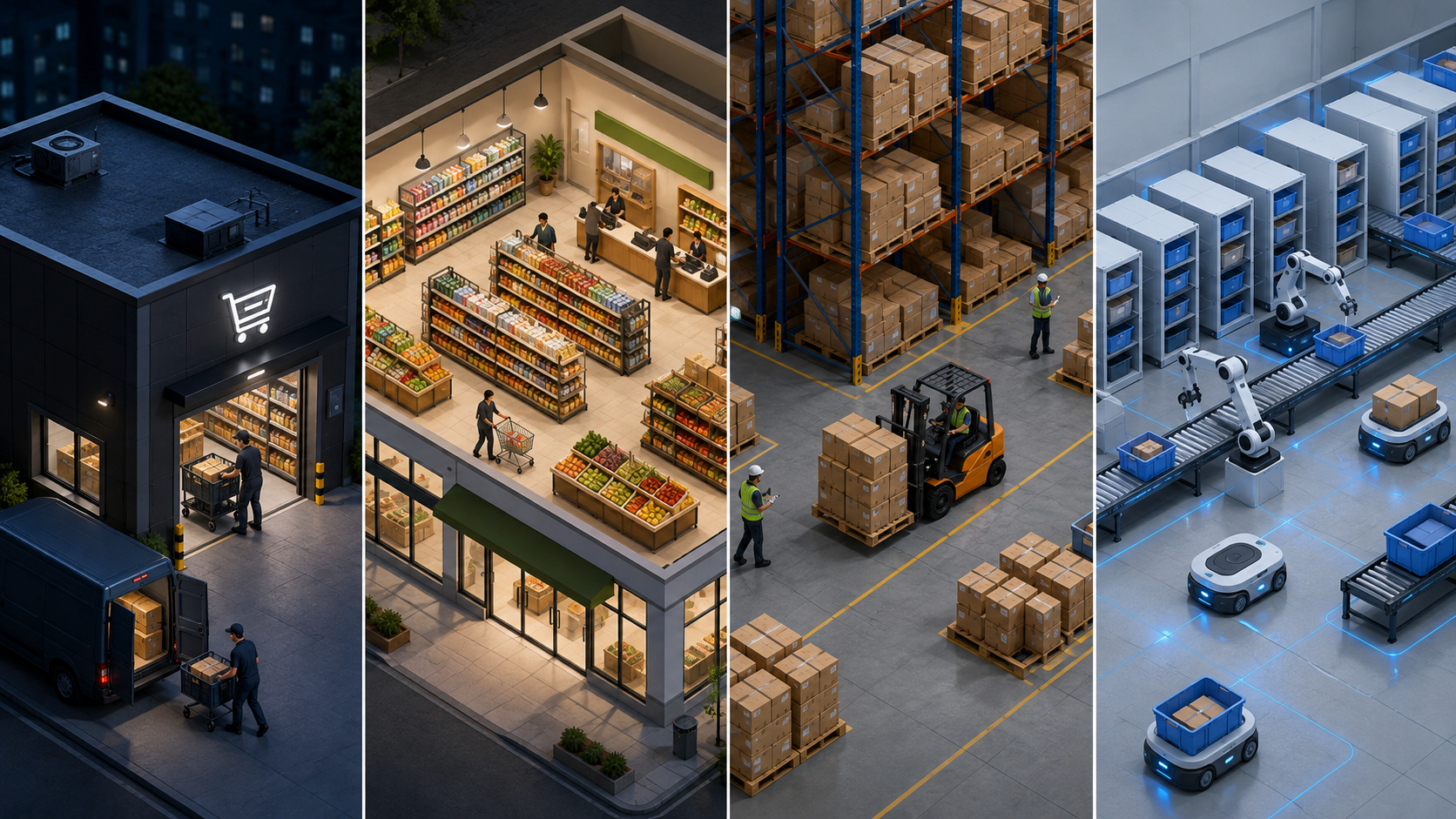
This is where the definitions blur, so it helps to separate them side by side:
| Facility | Who’s inside | Primary job | Typical size |
| Traditional store | Customers and staff | Sell in person | Retail floor |
| Dark store | Pickers only (no customers) | Fulfill online orders locally | Converted shop or small depot |
| Warehouse | Staff, often automated | Store bulk inventory and ship regionally | Large, industrial |
| Micro-fulfillment center (MFC) | Automation plus few staff | Fill orders in a very small footprint | Compact, sometimes inside an existing store |
The key distinctions: a warehouse holds large stock and ships across a region; a dark store is usually a repurposed retail space positioned close to customers for fast local delivery. A micro-fulfillment center (MFC) is even smaller and more automated, sometimes tucked into the back of an existing store or a parking structure, and optimized for a limited SKU range at high speed.
How a Dark Store Differs From a Regular Store
The easiest way to understand a dark store is to look at what a regular store does and flip it. A regular store exists to sell in person: it invests in a visible storefront, window displays, checkout counters, and a layout that encourages browsing. Its primary customer is a shopper who walks in, picks items off shelves, and pays at the till.
A dark store keeps the physical space but removes the shopper from the equation. There are no walk-in customers, no checkout counters, and no public storefront. The aisles are still stocked, but they’re laid out for pickers with order lists, not for browsers making impulse purchases. The space exists solely to get online orders picked, packed, and dispatched quickly.
| Feature | Regular store | Dark store |
| Who’s inside | Shoppers and staff | Pickers and couriers only |
| Primary job | Sell in person | Fulfill online orders |
| Storefront | Signage, window displays, walk-in entrance | Closed or unmarked, no public access |
| Checkout | Tills for customers | None , packing and dispatch only |
| Aisle layout | Built for browsing and merchandising | Built for fast, accurate picking |
| Location priority | Foot traffic and visibility | Proximity to delivery areas |
| Stock display | Facing customers, impulse-friendly | Stored for retrieval speed |
The crucial shift is purpose: a regular store spends money to attract and serve walk-in customers, while a dark store spends it to move online orders faster. That single change ripples through everything: location, layout, staffing, and technology.
Dark Store Automation Levels: Manual vs Automated Picking
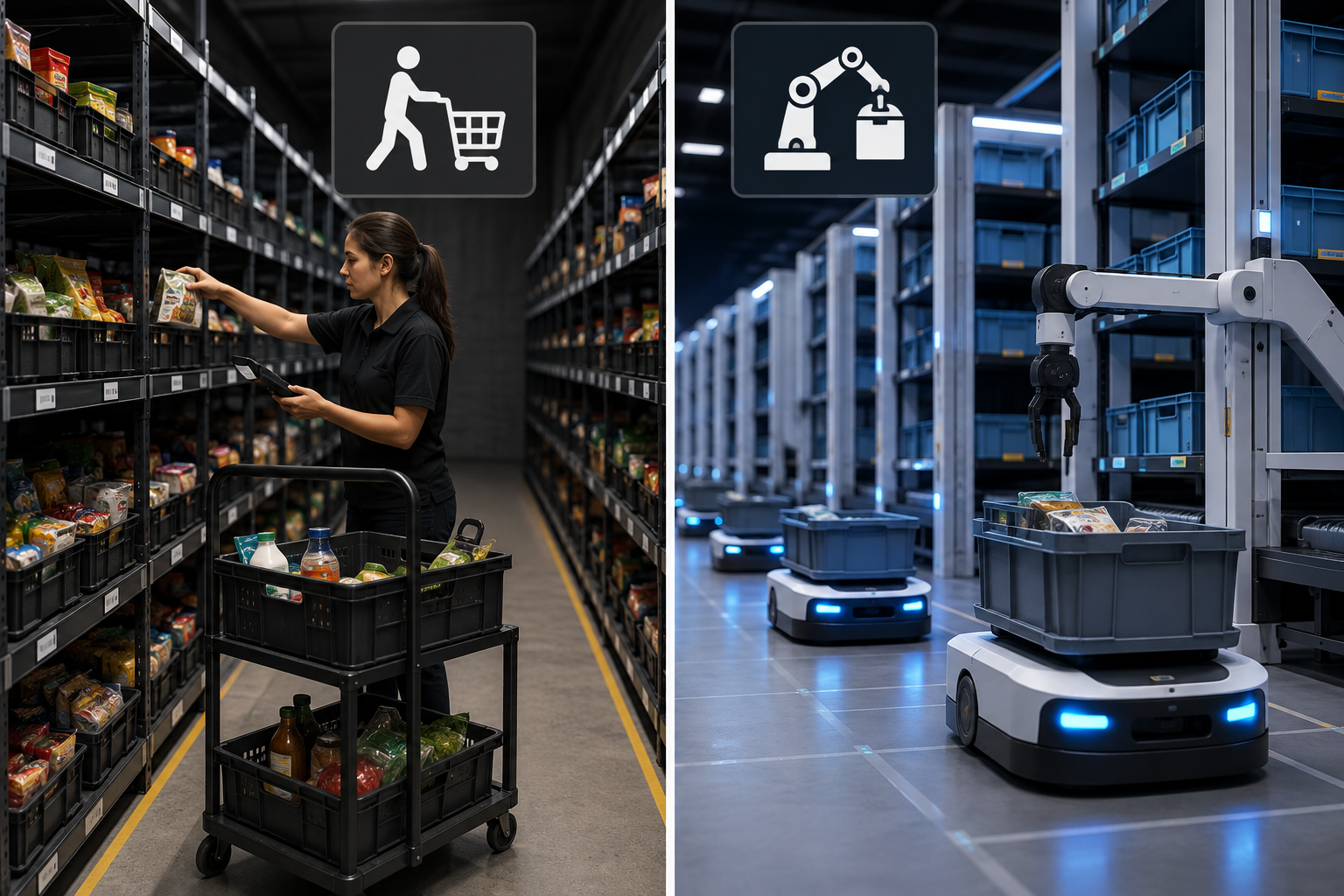
Not all dark stores are created equal. The biggest operational difference is how picking happens, and it runs along a spectrum from fully manual to fully automated.
Manual picking dark stores – These are typically converted retail stores where human pickers walk the aisles with handheld scanners or paper pick lists. Setup costs are low; you reuse the existing shelving and layout, and you can launch quickly. The trade-off is labour: throughput depends on how many pickers you schedule, and accuracy depends on their speed and care. Manual picking suits lower order volumes and mixed, hard-to-automate product ranges.
Automated and semi-automated dark stores – At the other end, robotics and warehouse management software (WMS) do the heavy lifting. Goods-to-person systems bring shelves to the picker, autonomous carts ferry totes to packers, and AI-driven inventory systems track stock in real time. The benefit is throughput and accuracy at scale; the cost is a much higher setup bill and longer time to go live.
The hybrid reality – Most dark stores today sit somewhere in the middle. A retailer might automate storage and retrieval but keep human pickers for fragile or irregular items, or use conveyor systems for transport while people handle packing and quality checks. Full “lights-out” automation is still rare and reserved for high-volume, highly standardised operations. In practice, the question isn’t usually “manual or automated”; it’s how much of each a given order profile can justify.
Benefits of Dark Stores
The advantages of dark stores come down to speed, cost, and focus. Because the space exists to serve one job online order fulfilment it can be optimised in ways a public store never can.
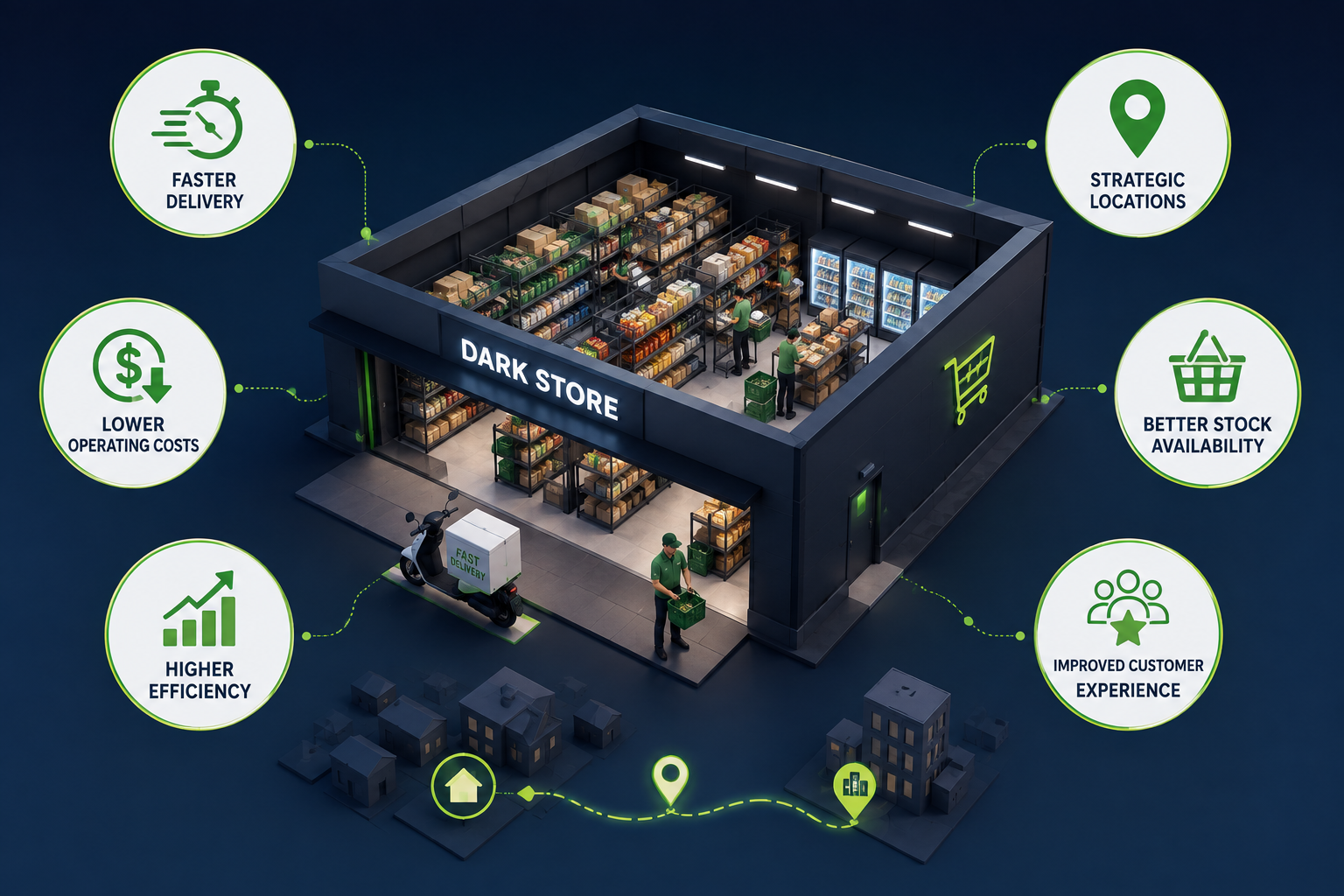
- Faster fulfillment – Being close to customers enables delivery in hours rather than days, which is the whole premise of quick commerce. Operators can promise 10- to 30-minute windows that a central warehouse simply cannot meet.
- Lower real estate cost – Dark stores can live in cheaper non-retail or back-street locations, since foot traffic and storefront appeal no longer matter. You also save on prime rent, signage, fixtures, and the constant re-merchandising that a public floor demands.
- Better inventory accuracy – A single-purpose picking space with focused stock control produces fewer stockouts and misplaced items. Stock levels sync directly to what the online store shows, so customers see fewer “out of stock” surprises after they order.
- Higher picking efficiency – Aisles are laid out for pickers, not browsers: fast movers up front, complementary products grouped together, no need to work around customers. More orders get picked per hour per person.
- No in-store disruption – Pickers don’t compete with shoppers for aisle space, so orders get filled without slowing down (or being slowed down by) a public sales floor. It also removes the awkward sight of staff with carts blocking the way.
- A scalable last-mile network – Several small dark stores spread across a city cut the average delivery distance and cost, turning fast local delivery into something that works at scale rather than a premium service.
- A second life for underperforming retail – Struggling storefronts can be converted into fulfilment points, recovering value from space that no longer earns as a shop.
Challenges of Dark Stores
None of the benefits come free. Dark stores concentrate the hardest parts of retail picking, stock accuracy, and last-mile delivery into one small space, and each carries a real cost.
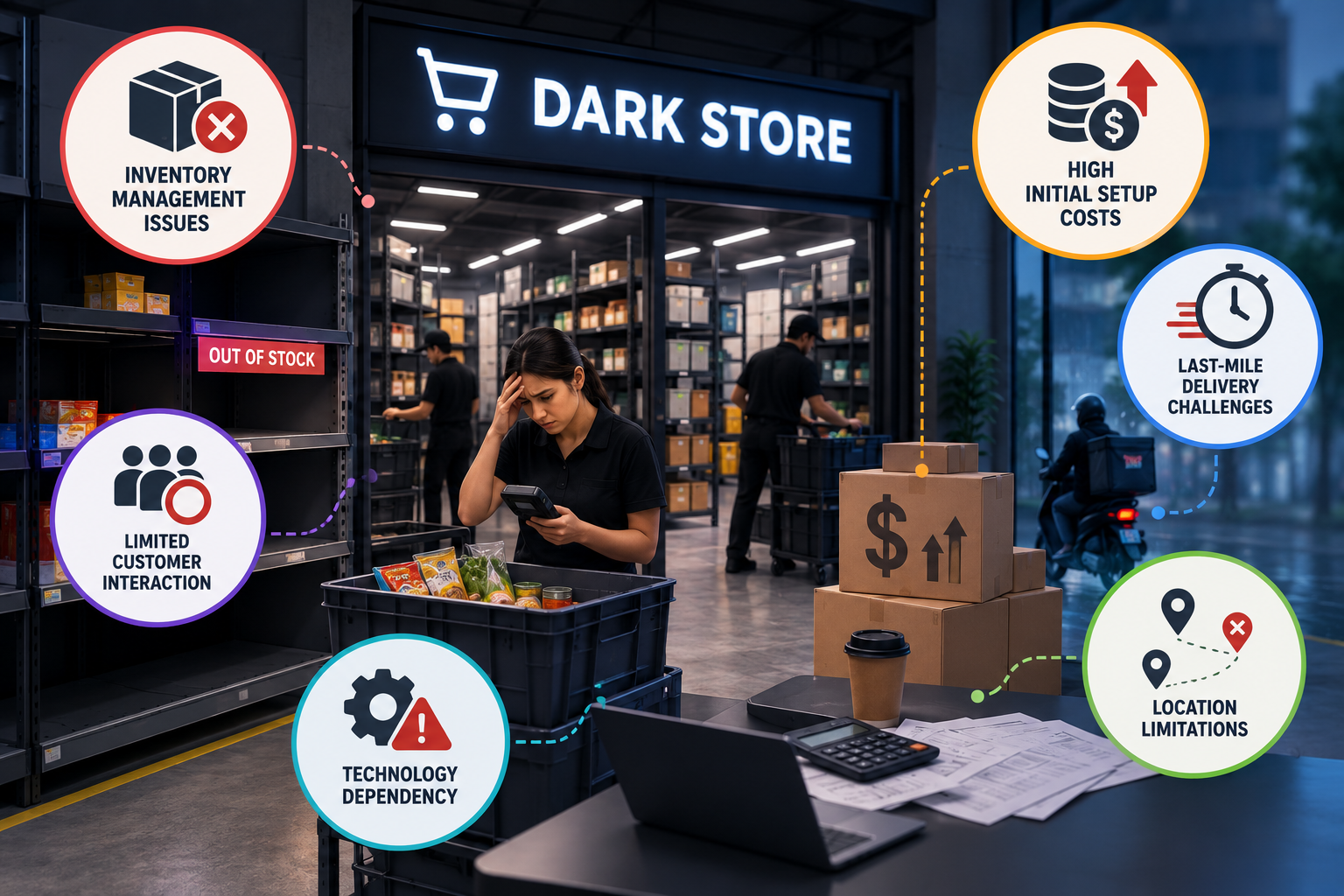
- High setup cost for automation – Robotics and WMS carry a steep upfront price that only pays off at significant order volume. A retailer that automates too early risks capital sitting idle when demand dips.
- Zoning and local pushback – Some cities have restricted dark stores over traffic, noise, and parking concerns around delivery hubs. Courier vehicles arriving at all hours can strain quiet residential streets and draw complaints.
- Inventory accuracy dependency – The whole model assumes the system knows exactly what’s on the shelf; a single miscount ripples into missed orders. Without real-time stock sync between the storefront and the picking floor, overselling is almost guaranteed.
- Labor management – Manual dark stores still depend on scheduling and training enough pickers, especially during demand spikes. Quick-commerce demand is notoriously peaky, which makes over- or under-staffing a constant risk.
- The last-mile problem – The final stretch from dark store to doorstep is the most expensive and least predictable part of the flow courier reliability, traffic, and temperature control for chilled goods all sit outside the retailer’s direct control.
- A narrower product range – Dark stores hold a curated assortment of high-turnover items, not a full catalogue. Customers who want the long tail still have to wait for a central warehouse, which can limit the model to everyday essentials.
- Thin margins and intense competition – Quick-commerce operators compete largely on speed and price, and the cost of local delivery erodes margin quickly. Only disciplined operators with enough order density survive the squeeze.
Who Uses Dark Stores?
Dark stores are most common where speed and density matter, a product range standardized enough to pick fast, and a customer base close enough to make local delivery worthwhile. Across those conditions, several distinct groups have adopted the model:
- Grocery and quick-commerce operators: The largest users. Supermarkets and delivery-first apps run dark stores for same-hour delivery of everyday essentials, from fresh produce to pantry staples. The 10- to 30-minute delivery promise quick-commerce brands advertise is only possible because a small, hyper-local dark store sits minutes from the customer rather than in a regional warehouse. Some chains run a hybrid: a public store out front and a dark-store-style picking area out back.
- Pharmacies: Dispensing prescriptions and health products quickly is a natural fit the product range is compact, standardized, and frequently urgent. A pharmacy dark store lets an operator fill and dispatch orders without tying up a public dispensary counter or making customers wait behind pickers.
- Consumer packaged goods (CPG) brands: Brands that already know their best sellers can hold a tight assortment of high-turnover SKUs in a small local depot, then ship directly to nearby customers or retailers instead of routing every order through a distant distribution center.
- Large and multichannel retailers: Chains with existing store networks convert underperforming locations into fulfillment-only spaces, or build small depots near dense customer bases. A store that no longer earns as a shopfront can recover value as a local order hub the same aisle space, repurposed for pickers instead of browsers.
- Restaurants and meal-delivery operators; The term usually means retail goods, but the same fulfillment-only logic powers the “ghost kitchen” side of food delivery: a kitchen with no dining room, built purely to prepare orders for couriers. The shared principle is identical: strip out the walk-in customer and point every square foot at dispatch.
- Direct-to-consumer (D2C) sellers: Growing online brands use compact, customer-adjacent fulfilment points to offer same- or next-day delivery in specific cities without building a national warehouse network. For a WooCommerce or Shopify seller, this is the practical version of the model: local stock, fast dispatch, and software that keeps the digital order flow accurate.
The common thread is the same across every user: a product range that’s standardized enough to pick fast, and a customer base close enough to make local delivery worthwhile. That’s what separates a dark store from a regional warehouse and why the model keeps spreading beyond groceries into nearly every category where speed is the product.
Dark Stores and Online Retailers
If you run a WooCommerce or Shopify store, it’s worth being clear about one thing: a dark store is a fulfilment and logistics model, not a plugin feature. No WordPress plugin turns a shop into a dark store. What software does affect is the order flow that feeds it.
A WooCommerce store acting as its own mini dark store needs the pieces that sit around picking and packing: shipping rules that price local delivery correctly (see WooCommerce Table Rate Shipping), packing slips that travel with each order (see WooCommerce PDF Invoices and Packing Slips), and checkout fields that capture the pickup or delivery details the order actually needs (see Checkout Field Editor and Manager). If you’re at the stage of configuring an online store at all, start with our WooCommerce setup tutorial. The dark store is the physical end of the chain; these tools are the digital end.
Conclusion
A dark store isn’t a new kind of retail, it’s a repurposing of it. Strip the walk-in customers out of a physical space and point every square foot at one job: getting online orders picked, packed, and dispatched quickly. That single-purpose focus is what produces the speed, inventory accuracy, and local-delivery economics a central warehouse cannot match, and it’s why grocery, pharmacy, and quick-commerce operators have leaned so heavily on the model.
The trade-offs are just as real. Automation carries a steep setup cost, the last mile is expensive, and the whole system only works when your inventory data is trustworthy. For most operators the sensible answer is the hybrid middle ground automate where volume justifies it, keep human pickers where flexibility matters.
If you run an ecommerce store, the takeaway is practical. You don’t need a dark store to sell online. But the moment you promise local delivery, fast fulfillment, or pickup from your own stock, you’re borrowing its logic and the digital end of that chain runs on accurate shipping rules, clear packing slips, and checkout fields that capture exactly where and how each order should arrive. Get those right and your fulfillment can run as smoothly as any dark store’s, whether your aisles are a warehouse shelf or a converted shop around the corner.
Acowebs are the developers of the WooCommerce PDF Invoices and Packing Slips which generate PDF invoices automatically and add them to the confirmation emails sent to your customers.WooCommerce invoice plugin allow you Create, edit, and modify your own templates and to download or print invoices and packing slips from the woocommerce email customizer using which you can easily build and customize WooCommerce emails with a drag-and-drop user interface.
FAQ
A dark store is a physical retail space converted to fill online orders without walk-in customers a closed storefront that only handles picking, packing, and dispatch.
Dark shopping is the customer-facing side of the dark store model: buying products online that are then picked, packed, and dispatched from a location the shopper never enters. It’s essentially ecommerce fulfilled from a closed retail space rather than a traditional warehouse.
No. A warehouse typically stores bulk inventory and ships across a wide region, while a dark store is a smaller, customer-adjacent space (often a converted shop) optimized for fast local delivery of a curated product range. The two can coexist: a dark store may draw stock from a larger warehouse.
In quick commerce, a “darkstore” (one word) is a compact, hyper-local fulfillment point that lets operators promise delivery in 10 to 30 minutes. It holds a tight assortment of high-turnover items and sits close enough to customers that couriers can reach them almost immediately.
Some are, but most are semi-automated. Full robotics exist in high-volume operations, while many dark stores still rely on human pickers with scanners and simple shelf layouts. The hybrid approach automated transport plus human picking and packing is the most common today.
Both fulfill online orders without serving walk-in customers, but a micro-fulfillment center (MFC) is smaller and more heavily automated, often built inside an existing store or parking structure to serve a limited SKU set at very high speed. A dark store is usually a larger, repurposed retail space that can operate with far less automation.