



















 Login
Login
 Cart
Cart
Agentic commerce is fundamentally reshaping how customers discover, evaluate, and purchase products online. As artificial intelligence becomes increasingly sophisticated, a new breed of autonomous AI agents is taking over the shopping journey, making decisions, comparing products, and completing transactions without direct human interaction. For online store owners, understanding this shift isn’t just interesting; it’s essential to remain competitive in 2026 and beyond.
The transition from traditional e-commerce to agentic commerce represents one of the most significant shifts in retail since the rise of online shopping itself. While many store owners remain focused on optimising for human browsers and search engines, savvy retailers are already preparing their infrastructure to be discoverable and attractive to AI shopping agents.
What Is Agentic Commerce?

Agentic commerce refers to the use of autonomous AI agents to handle the entire or partial shopping process on behalf of customers. Unlike traditional chatbots that answer questions, agentic shoppers actively complete purchasing tasks. For example, an AI agent might receive a customer’s instruction like “find me the best wireless mouse under $50 with USB-C connectivity,” then search multiple stores, compare specifications and prices, read reviews, evaluate availability and shipping times, and execute the purchase, all without asking for confirmation at each step.
The difference is crucial and worth giving importance to . A chatbot provides information reactively: you ask a question, it responds. An agent acts proactively. Where you might describe traditional e-commerce as “customers shop – businesses sell,” agentic commerce flips the model: “AI agents shop – businesses adapt to be discovered and chosen by AI.” This inversion has profound consequences for how you structure product data, market your offerings, and optimise your store.
This evolution is happening now, not in some distant future. Platforms like ChatGPT (with Instant Checkout), Microsoft Copilot Shopping, Google’s AI Mode, and Perplexity are already enabling agentic commerce at scale. Shopify and WooCommerce store owners who optimize for AI agent discovery are capturing early market share, those who ignore it risk irrelevance as the technology matures.
Agentic AI vs. Agentic Commerce
These terms are often confused, so let’s clarify precisely. Agentic AI is a broader category of artificial intelligence systems capable of autonomous reasoning and action; they set goals, make decisions, and take steps to achieve those goals with minimal human guidance. A legal research agent, a DevOps automation system, or a customer service bot that routes inquiries autonomously are all examples of agentic AI.
Agentic commerce is a specific application of agentic AI focused on commerce: autonomous agents that evaluate products and complete transactions. Not all agentic AI is commercial (a legal research agent or a DevOps automation agent serves different domains), but all agentic commerce relies on agentic AI principles.
For e-commerce, the practical distinction is that if the system acts on behalf of the shopper without asking permission at every step, it’s agentic commerce. The agent is authorised to compare, decide, and purchase within defined parameters, price limits, preferred brands, and acceptable shipping times set by the human customer but executed entirely by the agent.
Agentic Commerce vs. Traditional Ecommerce
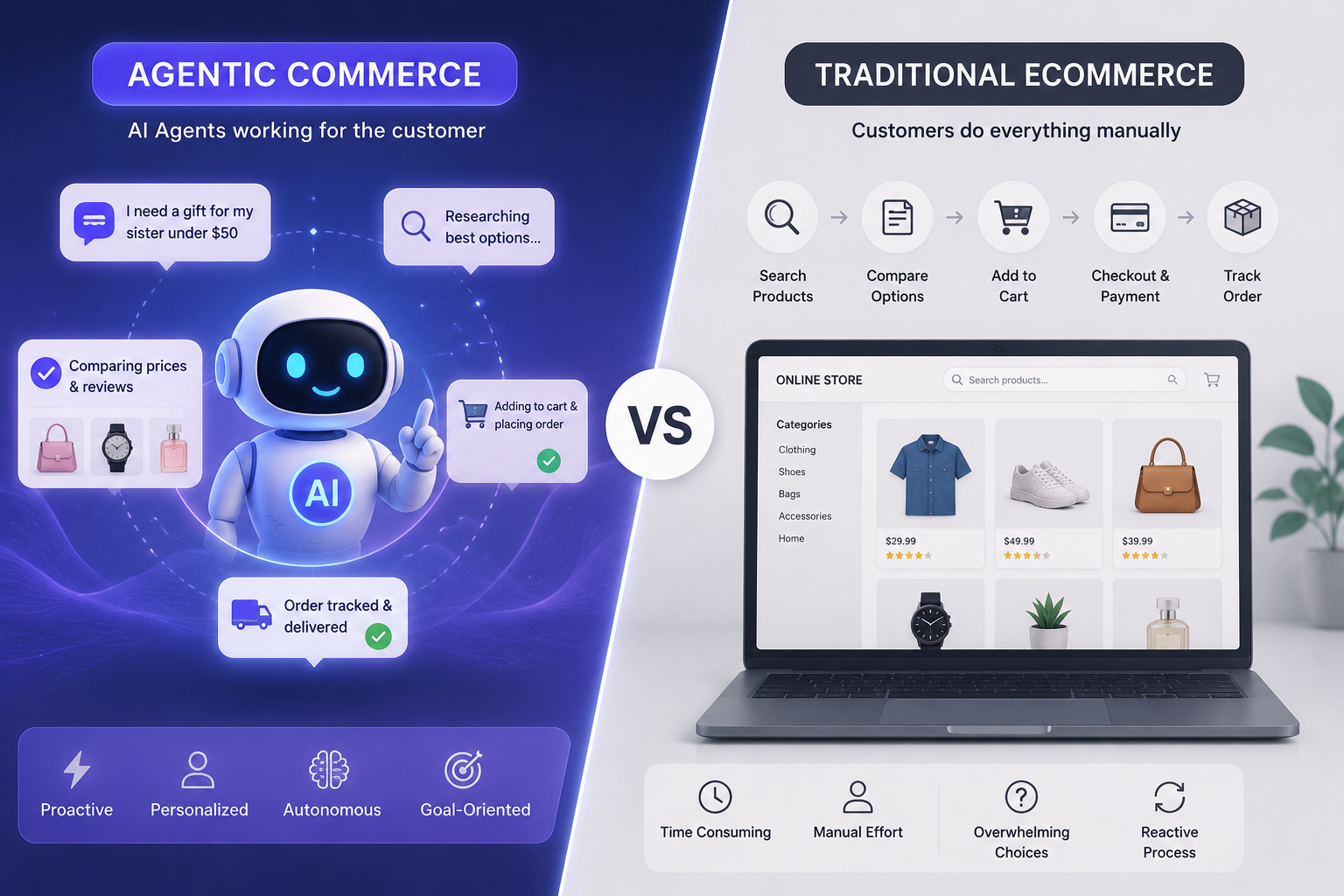
The shift from traditional e-commerce to agentic commerce introduces fundamental differences in how products are discovered, evaluated, purchased, and fulfilled. Understanding these differences is key to preparing your store:
| Aspect | Traditional Ecommerce | Agentic Commerce |
| Discovery | Customers browse product catalogs, search listings, or rely on recommendations to find products. | AI agents understand customer intent and discover products by querying APIs, structured product feeds, and merchant data. |
| Decision-Making | Customers manually compare features, prices, ratings, and reviews before making a purchase. | AI agents evaluate product specifications, pricing, availability, reviews, and other data programmatically to recommend the best option. |
| Checkout | Customers manually enter shipping details, payment information, and complete the checkout process. | AI agents use stored customer preferences and credentials to complete API-driven, largely invisible checkout workflows. |
| Data Requirements | Relies on marketing copy, product images, and basic product information to attract buyers. | Requires machine-readable product attributes, structured pricing, inventory data, and clearly defined product variants. |
| Merchant Control | Merchants control product presentation, merchandising, and the overall shopping experience. | Merchants provide accurate, structured data, while AI agents determine product relevance, ranking, and recommendations. |
| Key Success Factor | Strong user experience, persuasive product pages, and effective conversion optimization. | High-quality, accurate, complete, and machine-readable product data that AI systems can easily interpret and process. |
In traditional e-commerce, your product page design, good copy, and user interface directly influence conversion rates. You invest in beautiful photography, better descriptions, and optimised page flows because humans see them and respond emotionally. In agentic commerce, these are irrelevant; the agent never sees them. Instead, what matters is whether your product data is clean, complete, machine-readable, and consistent across all fields—titles, descriptions, variants, pricing, availability, and structured attributes.
Who Are Agentic Shoppers?
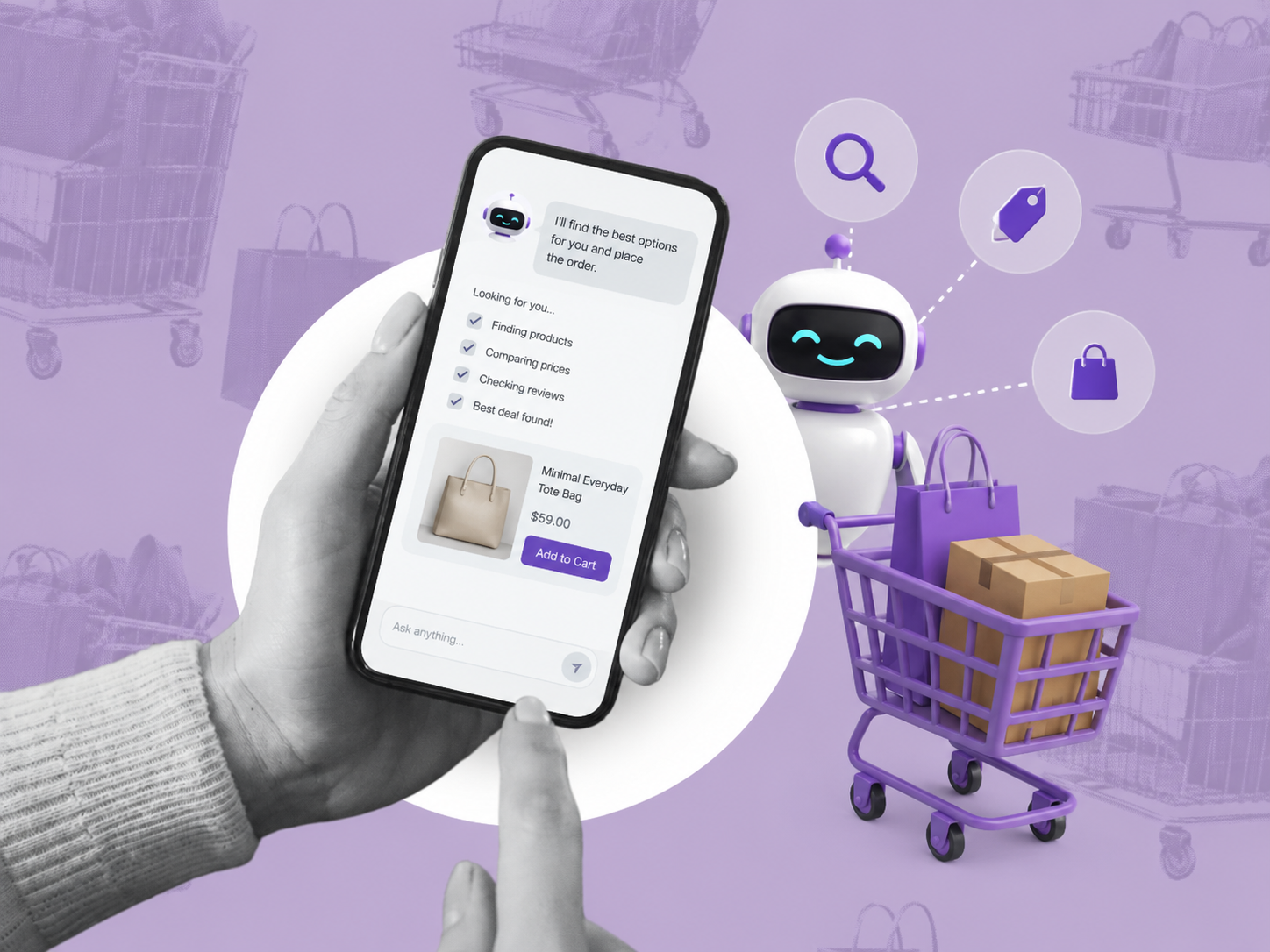
Agentic shoppers are customers who actively use AI agents to conduct product research and make purchases. They’re not a small group anymore. Early adoption data suggests that 15-20% of online shoppers in developed markets are already experimenting with AI-assisted or AI-driven purchases as of mid-2026. This demographic continues to grow rapidly as new platforms launch and existing tools improve.
Agentic shoppers share common traits:
- High intent: They know what they want (or at least what problem to solve) before delegating to an agent
- Time constrained: They prefer agents to handle routine shopping tasks, freeing up mental energy for higher-order decisions
- Price sensitive: They value agents ability to compare prices across multiple vendors instantly and identify the best deals
- Data driven: They trust algorithmic evaluation and specification comparison over marketing messaging and emotional appeals
- Platform flexible: They use whatever agent technology is available, whether that’s ChatGPT, Google, Copilot, Perplexity, or emerging specialized shopping AIs
- Efficiency focused: They see shopping as a task to optimize and delegate, not an entertainment experience
Younger demographics (Gen Z and younger millennials) show higher adoption rates, but the trend spans age groups and income levels as AI shopping tools become mainstream. 38% of US consumers have already used generative AI for online shopping, and 52% plan to; professionals, parents juggling multiple responsibilities, and anyone overwhelmed by choice lean towards agentic shopping solutions. Business buyers and repeat purchasers represent another growing segment: organisations that use agents to automate routine procurement.
How AI Shopping Is Changing Ecommerce
Several major platforms are now enabling agentic commerce at scale. Understanding each helps you prepare your store for agent discoverability.
- ChatGPT Instant Checkout: lets users shop directly within ChatGPT conversations. If a customer asks ChatGPT for a product recommendation, the AI can provide product links and enable purchases through integrated payment partners. This integration brings shopping into the conversational interface where millions of users spend time daily.
- Microsoft Copilot Shopping: integrates shopping assistance into the Copilot interface, enabling users to compare products, apply discount codes, check real-time inventory across retailers, and complete purchases. Microsoft’s integration into Windows, Office, and Edge positions this as a significant distribution channel.
- Google AI Mode: (part of Google’s Search Generative Experience) surfaces shopping recommendations directly in search results. The AI evaluates product quality, compares prices, and presents curated options, often with direct links to checkout. For retailers, this represents Google’s evolution from search engine to shopping agent coordinator.
- Perplexity: allows users to make purchases through Perplexity’s AI search interface, with the agent comparing options and handling checkout. Perplexity’s focus on research-driven search positions it well for complex purchasing decisions.
- Emerging Vertical Agents: specialized shopping AIs focused on specific categories (fashion, travel, electronics, groceries) are launching continuously, each with its own discovery and purchasing mechanisms.
What ties these together: they all rely on product data feeds, APIs, and structured data to identify and evaluate products. Your WooCommerce or Shopify store must be discoverable and readable by these agents. That means clean product data, proper schema markup, consistent pricing, clear inventory status, and accurate attributes- the operational foundation of modern eCommerce that too many stores misses.
Why Agentic Commerce Matters for WooCommerce & Shopify Store Owners
For online retailers, agentic commerce presents both opportunity and urgency.
- Opportunity: Early adopters who optimize their stores for AI discoverability enjoy a first-mover advantage. As agentic shopping becomes standard, your optimization efforts compound. A store with clean product data and proper structured markup will appear in AI agent results more frequently, earning more traffic and conversions than competitors who haven’t adapted. You’re building competitive defense in data quality and agent compatibility that take time to replicate.
- Urgency: Traditional SEO strategies optimized for human search behaviour and user experience aren’t sufficient for AI agents. Agents don’t read persuasive product descriptions or evaluate page design in the way humans do. They simplify structured data, compare attributes programmatically, and make decisions based on specifications, pricing, availability, and ratings. Stores that fail to prepare risk becoming invisible to AI, and as agentic commerce grows, that means invisible to a growing percentage of your market.
For Shopify and WooCommerce store owners specifically, the stakes are high because platform-sceptic agents often compare across multiple stores. If your product data is incomplete or inconsistent while a competitor’s is authentic, the agent will favour your competitor every time. The algorithm becomes a permanent competitor penalty until you fix it.
How to Prepare Your Store for Agentic Commerce

Preparing your store for agentic commerce isn’t about redesigning your website; it’s about ensuring your product data is machine-readable, complete, and consistent. Here’s the roadmap:
1. Clean, Complete Product Data
Agents need accurate, comprehensive product information to evaluate fit. Audit every product and ensure:
- Product titles are descriptive and include relevant attributes (brand, color, size, type) but don’t rely on marketing hype or keyword stuffing
- Descriptions are thorough and factual, covering specifications, materials, dimensions, use cases, and limitations
- Variant data is explicit and uninterpretable; don’t hide colour or size variants in dropdown menus; structure them as distinct attributes that agents can parse independently
For WooCommerce stores using Variation Swatches, this becomes easier: you can present variants visually to humans while ensuring the underlying data is machine-readable and complete. Agents see the structured variant data; humans see the visual interface.
2. Structured Data and Schema Markup
Implement schema.org markup so agents understand your products without guessing. At minimum:
- Use Product schema with name, description, price, image, and review rating
- Include Aggregate Rating if you have customer reviews (ratings and review count)
- Add Availability markup (in stock, out of stock, pre-order, with expected restock dates)
- Use Price Specification for discounts or tiered pricing
- Include Brand and Manufacturer schema to help agents understand product provenance
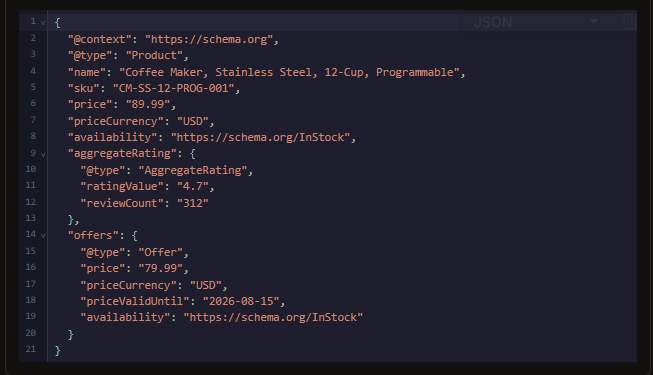
Google, ChatGPT, Perplexity, and emerging agents all simplify schema markup. Agents use it to quickly understand product attributes without simplifying text or inferring meaning. Well-structured markup becomes a competitive advantage.
3. Consistent, Machine-Readable Pricing
Pricing inconsistency frustrates agents and erodes customer trust. Ensure:
- Base prices are consistent across all channels (website, data feeds, APIs, partner integrations)
- Promotional pricing is clearly marked with start/end dates and discount percentages
- Currency is explicit and consistent (don’t mix USD and cents notation)
- Discounts and rules are encoded in structured fields, not hidden in marketing copy or descriptions
If you use WooCommerce Dynamic Pricing with Discount Rules Pro, you can create complex pricing rules for different customer segments while maintaining a clean underlying data structure that agents can interpret. The same applies to tiered discounts, bulk pricing, and seasonal promotions.
4. Clear Checkout Structure
For agents that conduct transactions on behalf of customers, your checkout must be:
- API-compatible: Agents need programmatic access to checkout endpoints so they can complete transactions without manual input
- Minimal required fields: Agents can’t fill out unnecessary fields; every field should be essential and serve a purpose
- Payment flexibility: Support multiple payment methods and stored preferences so agents can proceed without customer friction
The WooCommerce Checkout Field Editor lets you streamline checkout by removing fields unnecessary for specific product categories or customer segments, making the process faster for both human and agent checkout flows.
5. Clear Product Differentiation
Agents compare your products to alternatives. Help them understand what makes yours unique:
- Use product labels to highlight key attributes (eco-friendly, premium, budget-option, bestseller, new arrival)
- Tag award-winning or highly-rated products so agents can factor awards into their comparison logic
- Include unique selling points and differentiators in structured fields, not just marketing copy
- Use comparison tables within product descriptions to help agents evaluate your product against alternatives
WooCommerce Product Labels lets you add visual and semantic labels that agents can interpret programmatically, giving you control over how your products are presented to AI comparisons.
6. Unambiguous Variant Data
If your products come in multiple variants (color, size, material, capacity), structure them clearly:
- Each variant should have distinct, non-overlapping attribute values (don’t use “black” and “midnight black” interchangeably)
- Avoid text fields for variants; use predefined attribute taxonomies so agents recognise equivalence
- Ensure variant images, pricing, and inventory are distinct and clear
- Provide variant-level SKUs and barcodes for fulfillment clarity
Variation Swatches for WooCommerce makes this seamless for customers while keeping the underlying data clean and machine-readable for agents.
7. Crawlable Reviews and FAQs
Customer reviews and FAQs are evaluation signals for agents. Ensure:
- Reviews are properly marked with schema (Review schema with rating, text, and reviewer name)
- FAQs are structured with FAQ schema (question/answer pairs)
- Both are crawlable (not hidden behind JavaScript, modals, or login walls)
- Reviews include helpful signals like verified purchase badges and review date
The Future of Agentic Commerce

Looking ahead, agentic commerce will evolve in several directions.
- Agent-to-agent negotiation will emerge: your store’s data API might communicate directly with customer agents to negotiate prices, bundles, or delivery terms, all without human involvement. Imagine an agent requesting bulk discounts, custom variants, or priority shipping, and your API automatically responding with available options.
- Autonomous reordering will become standard for consumables: a customer’s agent will monitor inventory and automatically reorder coffee, supplements, office supplies, or household items based on usage patterns and delivery windows. Stores that excel at retention through predictive ordering will capture recurring revenue.
- Cross-platform optimisation will intensify: agents will compare not just prices but entire supply chains, sustainability metrics, ethical sourcing practices, and delivery speed. This gives stores new competitive dimensions beyond price, but only if you make this data available in structured form.
- Privacy and data governance will become increasingly important as agents handle more purchasing authority. Stores that provide transparent, secure agent APIs will gain an advantage over those that resist agent access.
For store owners, the message is clear: optimise your product data now, before agentic commerce becomes dominant. The stores that do will thrive; those that ignore it will fade into agent-invisible oblivion.
CONCLUSION
Agentic commerce isn’t coming. It’s here. Right now, agents are shopping thousands of stores. Your store is either ready or it isn’t. The good news? Getting ready doesn’t require a technical overhaul. It requires discipline: clean product data, accurate specs, standard formats, and honest pricing. Start this week. Audit your top 10 products. Rewrite titles, add schema, standardize variants. Test your checkout. By next month, you’ll be catching agentic traffic your competitors are missing. And in 6-12 months, when everyone else realizes they need to do this, you’ll already have months of agentic revenue under your belt.
Acowebs are the developers of WooCommerce Product Labels which is an optimized, lightweight, and effective plugin that is simply the best way to add custom badges and labels to your WooCommerce products or categories.WooCommerce sales badges also comes with a drag and drop label editor, multiple label styles, and scheduling options to display labels for a set time period.
WooCommerce Variation Swatches plugin which allows you to replace default dropdowns with visual swatches such as color, image, button, and radio for your product variations, making it easier for customers to pick the right option.
FAQ
Agentic commerce is the practice of using autonomous AI agents to handle product research, comparison, and purchasing on behalf of customers, without requiring human approval at each step. The agent acts within customer-defined parameters (budget, preferences, acceptable brands) but executes the decision independently.
Chatbots answer questions reactively when prompted. Agents act proactively, making decisions and completing transactions autonomously based on customer intent and directives. A chatbot is a tool; an agent is a decision-maker.
No. Agentic commerce applies to any online store,Shopify, WooCommerce, custom platforms, or marketplaces,that wants to be discoverable by AI agents. The principles are universal.
Not strictly. Basic preparation involves ensuring clean product data and adding schema markup. However, plugins like WooCommerce Product Labels, Variation Swatches, Dynamic Pricing with Discount Rules Pro, and Checkout Field Editor streamline the process for WooCommerce stores and make it easier to maintain data quality at scale.
Yes. Agents use the same payment processing infrastructure as traditional e-commerce. Payments are encrypted, processed securely, and subject to the same fraud protections. Customers maintain control over agent permissions and spending limits through their agent configuration.
Adoption is accelerating. Early data suggests 15-20% of online shoppers in developed markets are already using some form of AI-assisted or AI-driven purchasing as of mid-2026. Mainstream adoption (50%+ of online shopping) is likely within 2-3 years as platforms improve and distribution expands.
Audit your product data for completeness and consistency. Add or update schema markup to ensure agents can parse your catalogue. Ensure your store is discoverable by search engines and APIs. Consider plugins or tools that help maintain clean, structured product information. The stores that prepare first will capture market share first. Don’t wait for agent adoption to become mainstream before optimizing; the infrastructure you build now will pay dividends as the market shifts.