




















 Login
Login
 Cart
Cart
TL;DR: Consumer behaviour is driven by a blend of psychological, social, personal and situational factors. For digital marketers, the most actionable approach is to map these factors to observable signals (search queries, session paths, engagement, and transactions), segment audiences by intent, and run iterative experiments that reduce friction at high-value touchpoints. This article updates classic consumer behavior theory with practical analytics and a marketer’s playbook for improving conversion, average order value, and customer lifetime value.
In the pulsating heart of 2026’s hyper-connected economy, consumer purchasing decisions have ceased being transactions; they are symphonies of thought, feeling, and algorithm-driven prompts, with a scroll of TikTok erasing months of brand loyalty. Worldwide e-commerce purchases are estimated to reach $6.88 trillion this year, which is 7.2% greater than the volume in 2025, and Gen Z and Alpha cohorts have $500 billion in global discretionary influence, meaning, as with any brand, comprehending these choices is the key to success in the era of AI-supported personalization and Web3 micropayments.
However, in the face of economic turmoil, climate demands, and the emergence of the so-called quiet luxury minimalism, what actually makes the purchase button? Artificial scarcity algorithms enhanced by psychological urges such as FOMO (fear of missing out)? Social evidence through influencer micro-narratives? Or new technologies such as haptic feedback in AR try-ons, which de-materialize digital-physical space?
This is a deep dive into the complex aspects of consumer purchasing behavior based on the McKinsey 2025 State of the Consumer report and foresight by Ericsson into the so-called Internet of Senses. We will teach drivers of psychology, social, cultural, personal, economic, and technological, filled with language of the 2025 – think hyper-personalization through behavioral modeling, predictive, and nudge architecture within omnichannel ecosystems. Looking out to 2030, we will make projections of neurolutions in marketing and co-innovative, self-generated metaverse commerce, where decisions become immersive and bio-responsive rituals. To marketers, policymakers, and consumers, these insights help illuminate a future where purchases are not just made but are predicted, morally designed, and co-created.
With the trends around the world moving towards a more eco-friendly and eco-conscious approach to shopping, 72 percent of consumers, as Shopify trends point to, are seeking seamless omnichannel experiences, combining voice shopping with drone-delivered immediate satisfaction. These variables, in an age of data sovereignty and privacy-by-design requirements in the GDPR 2.0, are dynamically responsive, influenced by real-time social listening sentiment analysis. Buckle up, it is a journey of 2500 words that will make you computer-reading, persuading, and future-proofing transacting art.
Prior to understanding the factors influencing consumer behaviour, here are a few categories that fall under one or a few of these factors that influence consumer purchase decisions.
Buyer Decision Process (5 stages)
The traditional marketing funnels comes with touchpoints which includes: Problem recognition, Information search, evaluation of alternatives, Purchase decision and Post-purchase behaviour. Ensure you implement this to influence consumer behaviour in 2026. Align marketing content and CRO tools for search, comparison pages and product-table evaluation, frictionless checkout for quick decision and foster post-purchase satisfaction.
Maslow & motivation (applied)
People have a few needs that trigger purchases, these are functional (utility), emotional (sustainability) and social (belonging). Leveraging this for effective communication while highlighting functional benefits via product specifications emotional storytelling in hero content, and social proof for belonging or emotional needs.
S-O-R (Stimulus Organism Response)
In e-commerce, stimulus refers to images, badges, and price; Organism means user perception and cognitive bias; Response is defined by click, add-to-cart, purchase. Even a minor visual change (badges, scarcity timers) can alter the perception (organism) stage by a large margin.
Behavioural economics nudges
Nudging is a popular behavior change approach that uses small interventions or intermediaries to “push” people to do the “right” thing without restricting their freedom of choice. A few examples are price anchoring, decoy products, limited-time offers and defaults. Just in case, even nudges have to be A/B tested – a great fit for one product line could mean a disaster for another one.
Psychological Factors: The Cognitive and Emotional Underpinnings.

The psyche, a maze of shortcuts, biases, and dopamine circuits, is the center of each purchase, which brands use with the help of the recent developments of behavioral economics. According to the updated framework of Rasmussen University (2025), psychological factors prevail, and most decisions are based on emotional appeal rather than rational judgment. The central effect is that of the endowment effect, which is enhanced by virtual possession in AR previews: Items that have been touched in digital form by the consumer are overvalued, and cart abandonment recovery increased by 25 percent through haptic simulations. As personalization becomes the emotional core of engagement, 75% of consumers now expect brands to deliver personalized experiences, and 61% are more likely to return to a website that provides such tailored interactions, reinforcing emotional attachment and influencing repeat behavior.
Nudge theory, now charged with AI micro-ndges, indirectly influences decision-making. Amazon has worked on its one-click evolutions to ghost carts, which, using neural network evidence of user preferences, fill in automatically, preventing decision fatigue in an attention-deficit world. FOMO, which was once temporal, is designed to signal scarcity: On sites such as Depop flash, Dynamic pricing software creates badges such as Only three left, which activate loss aversion, and cause impulse purchases to spike by 40% according to Exploding Topics.
Virtuosity is perception: Multisensory branding, through visual product representations and AI-generated ambient sounds, shapes taste expectations. Additionally, 55% of food product purchases in apps like Spotify-integrated grocery lists are influenced by sonic seasoning. The pyramids of motivations changed; the needs of Maslow have been overlapped with self-actualization in the form of what he calls experiential ownership, where buyers purchase items that allow them to co-create a narrative, such as NFTs offering VIP access to the metaverse.
Resolution of cognitive dissonance helps drive post-purchase loyalty: The Patagonia chatbots, which are being used to resolve the cognitive dissonance, can be considered as ‘regret-minising’ and help consumers reduce the feeling of remorse in the age of transparency. New: Neuro-linguistic programming (NLP) of ad wording, in which sentiment-scanned words, such as unlock your untapped potential, find an archetypal echo with subconscious mind processes, according to Clootrack behavioral analytics.
Habitual procurement is influenced by education from past encounters through the reinforcement plan and variable rewards during loyalty programs, such as gamified stars in Starbucks. As mental health awareness reaches its peak in 2025, wellness-aligned nudges (e.g., pause notifications on binge-scrolling) will prevent burnout, build trust, and long-term advocacy. When used ethically, these psychological levers make the transactions appear as transformative moments.
Social Influences: The Power of Networks and Social Proof.
People are collectivists, and in the 2026 social commerce boom, which reaches 2.9 trillion, social pressures override personal self-will, as 81 percent of decisions to buy are triggered by personal recommendations. Instagram micro-influencers and Discord communities fall under the category of reference groups that use the so-called social capital arbitrage, in which aspirational affiliations lead to status-signaling purchases in the case of limited-edition Supreme drops resold by blockchain marketplaces.
The social proof takes the form of algorithmic amplification: According to the trends of the Intelligence Node, user-generated content (UGC) on TikTok receives 28% conversion rates as opposed to polished advertisements. Family and opinion leaders, such as multi-generational TikToks influencing holiday spending, and role models like eco-advocacy celebrities drive their programs to sustainable brands, which have increased by 35% YoY.
Word-of-mouth (WOM) becomes an echo chamber’s approval or disapproval, which is enhanced by AI sentiment aggregators that reappear with hyper-relevant testimonials. B2B bleed-over to B2C has the committee consensus; the decisions at the enterprise level are reflected in group chats, which block individual whims. The gender and age factors remain: The kidfluencer influence of Gen Alpha accounts for half of parental purchases, combining play-based persuasion with AR co-shop.
Opposing forces appear: “Social fatigue” gives rise to such a phenomenon as authenticity audits, which are the disclosures that allow consumers to blockchain-authenticate influencers and curb astroturfing. Future sociality? Collective bargaining localized (DAOs) or decentralized autonomous organisations to democratize buying in bulk and transform individual to community loyalty.
These networks not only have an impact, but they also coordinate, transforming individual choices into symphony votes.
Cultural and Economic Factors: Macro Forces Shaping Micro Choices.
Culture, this invisible code of rules and standards, will be intertwined with economics in the polycultural market of 2026, when subcultures like cottagecore or gorpcore will shape niche consumption worth 500 billion dollars. The dimensions of Hofstede change: In Asian high-context societies, guanxi-based gifting ecosystems are preferable, whereas self-expressive customization of self-expression through 3D-printed personalization is the primary concern of individualistic Western societies.
There is economic elasticity in place: Amid an inflation rate of 3.2%, most purchases are made through micro-transactions, value-velocity shopping, UPI, or Apple Pay Later. Additionally, 62% are interested in affordable indulgences rather than luxury, according to Shopify. Income inequalities drive the aspirational arbitrage: Low-income groups use BNPL (buy now, pay later) and status symbols, while high-income groups pursue stealth wealth through discreetly luxurious heirlooms.
The backlash to globalization is in the form of hyper-local reflection of global impacts,ika-localism, i.e., the K-beauty mixed with ayurvedic sustainability in India. Sustainability itself becomes a cultural compass 64% of global consumers expressed concern about climate change in 2023. Uncertainty in the economy increases risk aversion: the buffer-buying phenomenon hoards necessities due to predictive stock market dashboard effects that anticipate shortages.
Cultural taboos change: After the #MeToo era, cultural brands are shunned by a new culture of consumerism, characterised by empowerment and a preference for non-inclusive brands (76% boycott companies that fail to pass a diversity audit). The economic volatility of crypto creates a phenomenon of DeFi decision deferral, wherein wallet integrations briefly halt impulse purchases during bear markets.
These macro currents, cultural waves, and economic tides cleverly carve the purchase seascape and require the agility and adaptability of the brands.
Personal and Technological Factors: Individual Interfaces with Innovation.
The idiosyncrasies of personalities, age, lifecycle stage, occupation, lifestyle, etc., intertwine with tech, forming custom funnels in decisions. In 2026, the customization of pitches is based on the life stage: Millennials’ sandwich generation is obsessed with multifunctional gadgets, whereas Boomers are seeking voice-activated companion commerce through Alexa routines.
The permeation is massive in terms of technology: Omnichannel seamlessness, where physical shelves are bridged by QR scans to virtual wardrobes, affects 89% of paths to purchase. The AI hyper-personalization, based on zero-party data collected through quizzes, presents so-called serendipity engines, which increase retention rates by 30%.

Mobile ubiquity gave rise to the so-called proximity purchasing: Geofenced messages initiate so-called now-or-never deals, and 5G-powered AR overlays allow customers to place furniture in real-time using 5G-based evolutions of IKEA Place. The transparency offered by blockchain will fight the lack of trust, allowing the provision of provenance proofs on ethical sourcing to influence 65 percent of eco-conscious buyers.
Individual ethics come into conflict with tech ethics: Privacy calculus compares convenience to data sovereignty, and ZKPs, which are trust-builders, are emerging. Gig workers prefer instant payments through flexi-finance applications, which personalize economic agency, occupationally.
The highest point of techno-personal fusion is in so-called embodied cognition shopping: spending on wearables like Oura rings, with recommendations to purchase through biometric stress indicators, anticipating emotional expenditure. These are what make the global personal, transforming the mass markets into shortsighted reflections.
Emerging Trends in 2026: Ethical Consumerism and Instant Gratification.
The spirit of 2026 is ethical consumerism and speed culture, which is transforming choices during climate reckonings and logistical jumps. Sustainability is not an option: 78 percent avoid brands that lack net-zero commitments, research by McKinsey found, which contributes to regenerative buying, in which biodiversity credits offset a purchase via token carbon credits.
The culture of instant pleasure prevails: UAV deliveries and checkout in under 10 seconds with a biometric scan are gratifiers of now-ism, and half of the surveyed people will abandon a cart after more than 2 minutes. The influencer ecosystems of social shopping, which now include live-stream co-buys, generate $1.2 trillion through a combination of community and business.
Privacy-conscious products boom: Data-minimalist gadgets such as DuckDuckGo-compatible smart fridges are of interest to 62 percent of privacy-conscious people who fear surveillance capitalism. Trends in inclusivity: Adaptive sizing AI combats body-shaming, making it a more potent force to empower diverse groups.
These are the trends in 2026: the decision dialect, because of ethical velocity, and the personalization that is exceptionally watchful.
Applying These Factors to E-Commerce: Integration with top tools or plugins
Understanding consumer psychology is only useful if you implement these insights into your store. Here’s how Acowebs tools directly address the key purchase factors:
1. Social Proof and Urgency with Product Labels
Product Labels create dynamic, attention-grabbing badges on your products:
- “New Arrival”: Triggers novelty-seeking behavior
- “Limited Stock”: Creates scarcity-driven urgency
- “Best Seller”: Leverages social proof
- “Sale”: Highlights value perception
Customers seeing these labels are more likely to click and purchase.
2. International Expansion with Currency Switcher
For global customers, Currency Switcher removes a major friction point. Showing prices in the customer’s local currency:
- Increases perceived value (a $50 item feels different than 4,500 INR)
- Reduces conversion friction for international shoppers
- Signals that your store welcomes global customers
This single feature can increase international conversion rates by 10-15%.
3. Price Optimization with Dynamic Pricing
Dynamic Pricing allows you to optimize prices based on customer segments, purchase history, and demand:
- Price-sensitive customers see competitive pricing
- Loyal customers get personalized offers
- High-demand products command premium pricing
- Seasonal adjustments maximize revenue
This directly addresses the economic factor of price sensitivity while maintaining healthy margins.
4. Reducing Decision Friction with CartEasy
One of the biggest barriers at purchase time is unanswered questions. CartEasy lets customers ask questions directly from the cart without leaving the page:
- Customers get instant answers about shipping, returns, sizing
- You capture hesitant buyers before they abandon
- Support happens at the moment of decision, not after
- Real-time assistance increases conversion and reduces post-purchase returns
Integrating Behavioral Science into Your Strategy
To convert more customers, apply these principles systematically:
- Map your customer journey: Identify where they are in the five-stage decision process and adjust messaging accordingly
- Leverage social proof: Ensure reviews, ratings, and testimonials are prominently displayed
- Create urgency strategically: Use limited-time offers, scarcity messaging, and countdown timers where authentic
- Simplify the decision: Reduce choice overload with “bestseller” recommendations and curated collections
- Remove friction: Optimize checkout speed, offer multiple payment methods, provide instant customer support
- Personalize the experience: Show relevant products based on browsing history and preferences
- Build trust: Display security badges, return policies, and brand credibility signals
- Address economic factors: Offer flexible pricing, payment plans, and clear value communication
Social Factors Influencing Purchases
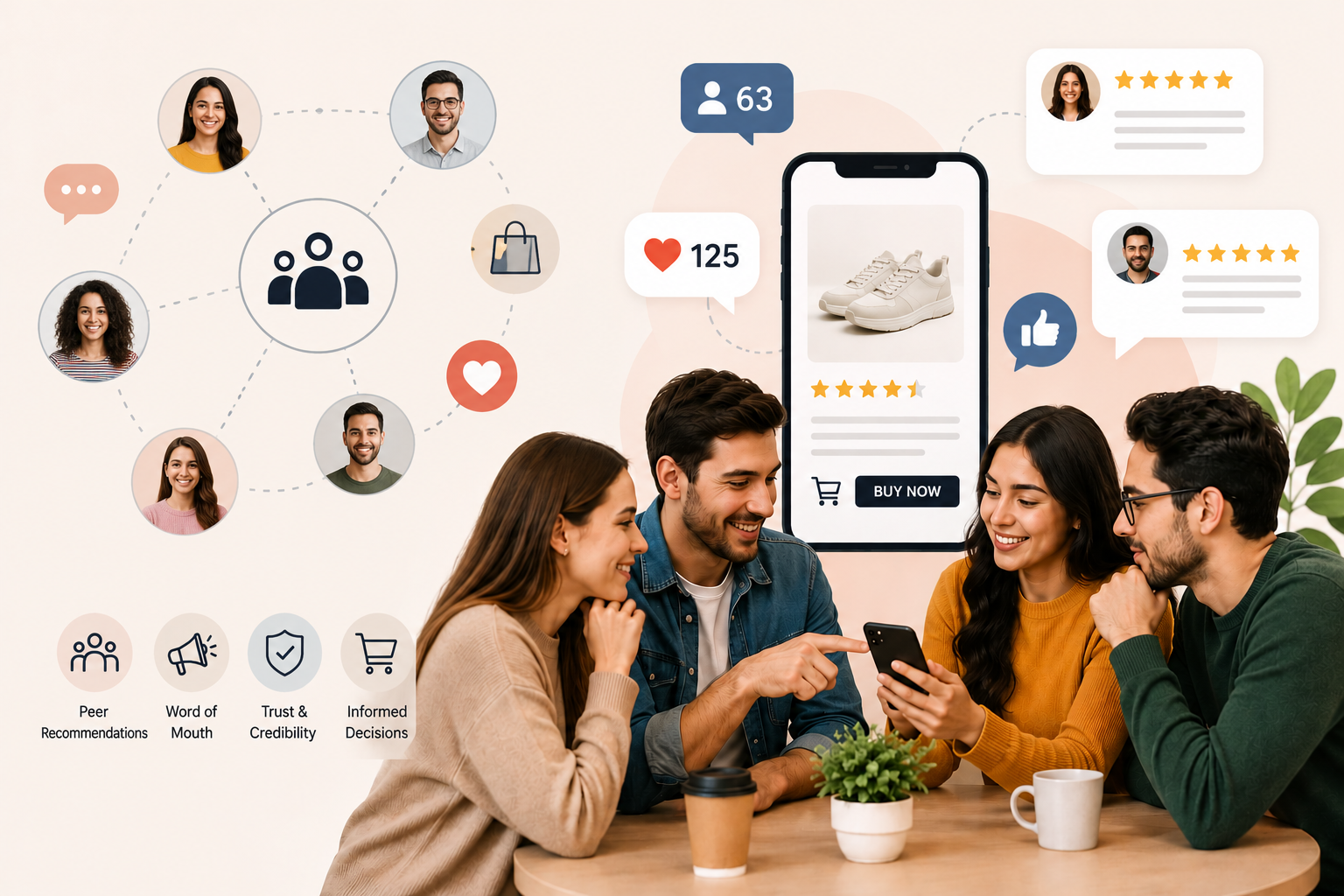
Humans are social creatures. We’re influenced by the people around us, the communities we belong to, and the culture we live in.
Social Proof and Peer Influence
Nielsen research shows that 92% of consumers trust recommendations from other people over brand messaging. This is why customer reviews, testimonials, and ratings are among the most powerful conversion drivers.
Where social proof matters most:
- Product detail pages (star ratings, review counts)
- At decision point (recent buyer badges, “verified purchase” tags)
- In pre-purchase messaging (customer testimonials, case studies)
- After purchase (review requests, user-generated content)
Impact of Online Reviews and Ratings
Online reviews have become a critical factor in consumer purchasing decisions, functioning as digital word-of-mouth. Key statistics:
- 72% of consumers read online reviews before making purchase decisions
- Products with 4+ star ratings convert 3.4x better than 2-3 star products
- Negative reviews increase trust: transparency about criticisms actually builds credibility since customers expect authenticity
- Review recency matters: reviews from the past 30 days are significantly more influential than older feedback
- Detailed reviews outperform generic praise: specific, concrete feedback addresses customer concerns and drives conversions
For e-commerce stores, review management is critical to success. Actively encouraging customer reviews, responding professionally to feedback (especially negative reviews), and displaying testimonials prominently can increase conversion rates by 20-30%. The most effective approach combines quantity (many reviews) with quality (detailed, specific feedback that addresses customer pain points).
Reference Groups and Brand Communities
Consumers often buy products to align with groups they admire or aspire to join. A fitness enthusiast might purchase premium gym equipment because they identify with athletes, or buy organic products because they want to be part of an eco-conscious community.
Successful brands build communities around their products , Apple enthusiasts, Lululemon’s yoga community, or Dyson’s tech innovator base. These communities create belonging and reinforce purchase decisions, leading to higher lifetime customer value and organic word-of-mouth advocacy.
Social Commerce: Instagram, TikTok, and YouTube Shopping
Social commerce has emerged as a dominant force in consumer purchasing behavior, fundamentally changing how consumers discover and purchase products.
Key metrics:
- 45% of consumers discover new products through social media (significantly higher for Gen Z and millennials)
- Social commerce is growing 3x faster than traditional e-commerce
- TikTok users are 51% more likely to purchase from creators they follow
- Instagram and Facebook account for 75% of social commerce sales globally
- Live shopping events drive urgency: viewers are 3x more likely to purchase during live streams
Social platforms function as both discovery and purchase channels. Influencer endorsements carry disproportionate weight,a recommendation from a trusted creator can drive purchase intent even before product research. User-generated content (customers posting unboxing videos, reviews, or styling tips) becomes social proof that rivals professional advertising.
For stores, mastering social commerce means:
- Investing in social presence and shoppable content
- Partnering with relevant micro-influencers aligned with brand values
- Creating authentic, engaging content (not overly polished ads)
- Making purchases frictionless without leaving the platform
- Responding to comments and building community engagement
Personal Factors and Individual Differences
Lifestyle and Values
A consumer’s lifestyle:how they spend their time and money:deeply influences what they buy. A health-conscious person purchases different products than someone focused on entertainment. A minimalist buys less frequently but invests in quality.
Sustainability and Ethical Purchasing
Modern consumers:particularly younger demographics:increasingly factor ethics and sustainability into purchasing decisions:
- 73% of global consumers are willing to change consumption habits to reduce environmental impact
- 62% of millennials prefer purchasing from sustainable brands, even at premium prices
- Supply chain transparency is now expected; customers want to know sourcing, manufacturing, and worker conditions
- Eco-friendly packaging influences purchase decisions; 45% of consumers pay more for sustainable packaging
- Certifications matter: Fair Trade, B-Corp, carbon-neutral shipping labels significantly increase purchase likelihood
For e-commerce stores, implementing sustainability messaging means:
- Clearly communicating sourcing, manufacturing, and sustainability practices
- Offering eco-friendly packaging options alongside standard options
- Highlighting relevant certifications and third-party verification
- Being transparent about product lifecycle and environmental impact
- Avoiding “greenwashing”:authentic sustainability builds trust; false claims destroy credibility
Brands embracing genuine sustainability build deeper customer relationships and command premium pricing. This factor is increasingly non-negotiable for attracting conscious consumers, especially Gen Z.
Age and Life Stage
Different generations exhibit distinct purchasing behaviors:
- Gen Z : Prioritize sustainability, social responsibility, digital-first experiences, and authenticity
- Millennials : Value experiences over possessions, influenced by social media, seek authentic brands
- Gen X : Practical, price-conscious, balance online and offline shopping
- Baby Boomers : Loyal to established brands, prefer traditional customer service, lower digital adoption
Motivation and Goals
Understanding what a customer is trying to achieve helps position products better. Someone buying a planner might be motivated by practical organization or aspirational self-improvement. Different messaging resonates with each motivation.
Subscription-Based Buying Habits
The subscription economy has fundamentally altered consumer purchasing patterns, shifting from one-time purchases to recurring commitments.
Key subscription metrics:
- Subscription commerce is growing 5x faster than traditional e-commerce
- 67% of consumers actively use at least one subscription service
- Millennials and Gen Z are significantly more likely to subscribe (72% vs. 45% for older generations)
- Subscription customers have 2.5x higher lifetime value than one-time buyers
- Monthly recurring revenue (MRR) is 5x more stable than one-time sales
The psychological appeal of subscriptions includes:
- Convenience : Products delivered automatically without re-ordering friction
- Predictability : Budget certainty with predictable recurring costs
- Value perception : Bundled offerings feel like superior deals compared to individual purchases
- Commitment and habit formation : Subscriptions create ongoing brand relationships and switching costs
For stores, subscription models unlock:
- Predictable recurring revenue streams
- Deeper customer relationships and engagement
- Lower customer acquisition cost (amortized over longer lifetime)
- Rich behavioral data for personalization
Success requires:
- Flexible subscription options (frequency, pause/resume, customization, cancellation)
- Clear value proposition and compelling first-offer discounts
- Easy management and hassle-free cancellation (retaining customer trust)
- Regular engagement (exclusive content, community, special offers) to prevent churn
Technological Factors and Modern Influences
Mobile Commerce and Mobile Shopping Behavior
Mobile has become the primary shopping channel for many consumers, creating new behavioral patterns:
- 79% of consumers make purchases via mobile devices
- Mobile abandonment rate is 23%:higher than desktop:meaning friction costs significantly more
- One-second page load delays reduce mobile conversions by 7%
- One-handed checkout functionality (large buttons, simplified forms) strongly correlates with higher conversion
Mobile shoppers operate in “micro-moment” mode:they want quick answers and instant gratification. This requires:
- Streamlined checkout (1-2 clicks maximum)
- One-handed navigation and touch-friendly design
- Click-to-call and live chat support
- Lightning-fast loading times (sub-2-second target)
- Clear product images, specifications, and reviews on small screens
- Mobile-first design (not desktop design squeezed to mobile)
Stores optimizing for mobile-first behavior capture impulse and time-sensitive purchases that desktop shoppers may abandon.
AI-Powered Purchase Recommendations
Artificial intelligence has revolutionized product discovery and personalization through algorithmic analysis of customer behavior and patterns.
AI recommendation impact:
- 35% of all e-commerce revenue comes from personalized recommendations
- Stores using AI personalization see 20% higher conversion rates than those without
- Recommendation emails have 3x higher open rates and 2.5x higher click-through rates
- Dynamic product pages adapting content by visitor segment increase engagement and conversions
- AI can predict future needs: showing products before customers consciously search for them
AI recommendations work because they:
- Reduce choice paralysis (showing 10 relevant products instead of 10,000)
- Anticipate needs based on behavioral patterns
- Cross-sell and upsell intelligently (based on actual data, not assumptions)
- Create personalization that feels intuitive and understanding
For e-commerce platforms, AI recommendations are now table-stakes. Customers expect relevant product suggestions, not random merchandising. Winning stores combine AI with human curation and merchandising expertise to create seamless discovery.
Personalization and Customer Experience
Personalization extends far beyond product recommendations to the entire customer journey.
High-impact personalization elements:
- Personalized landing pages (content varies by traffic source, visitor segment, device, referrer)
- Dynamic pricing (segment-based, loyalty-based, demand-based pricing)
- Personalized email marketing (timing, subject lines, product selections, offers tailored to individual behavior)
- Customized product bundles (suggested combinations based on purchase history)
- Adaptive website content (copy, imagery, CTAs, layout varying by visitor profile)
- Personalized customer service (agents equipped with full purchase history and preferences)
Research demonstrates:
- Personalization increases online revenue by 6-10x
- 80% of consumers prefer shopping at personalized experiences
- Personalized experiences reduce cart abandonment by 25%
- Returning customers expect personalization; lack of it signals indifference
The customer experience is now the primary competitive differentiator:not price or product selection, but feeling understood and individually served. Brands mastering personalization at scale win customer loyalty and command premium pricing.
Omnichannel Shopping Behavior
Modern consumers don’t distinguish between “online” and “offline”:they expect seamless experiences across channels.
Omnichannel shopping patterns:
- Research online, buy offline (showrooming: researching online, purchasing in-store)
- Research offline, buy online (reverse showrooming: comparing in-store, ordering online)
- Start on one device, finish on another (begin browsing on mobile, complete purchase on desktop)
- Mix of support channels (chat, phone, email, in-person, social media)
- Expectation of unified inventory (customers expect to know real-time stock across locations)
Omnichannel success requires:
- Unified inventory systems : Real-time stock visibility and updates across all locations
- Flexible fulfillment options : Buy online/pickup in store (BOPIS), ship-from-store, same-day delivery
- Consistent experience : Identical branding, messaging, pricing, and quality across channels
- Integrated customer data : Recognizing and serving customers consistently across touchpoints
- Connected support : Seamless handoffs between channels (start chat on mobile, continue with agent)
Omnichannel mastery drives:
- 3x higher customer lifetime value compared to single-channel customers
- 89% higher repeat purchase rates for omnichannel customers
- Premium pricing power : Customers pay more for convenience and integration
- Reduced returns : Customers who research thoroughly across channels are more confident
Future Prospects: 2030s Immersive, AI-Augmented Decision Ecologies.

By 2030, consumers will make purchases that are beyond cognition, and are in the realms of the internet of senses, where Ericsson projects brain-computer interfaces (BCIs) to recreate flavors or scents before buying a product. According to ConsumerLab, AI simulations, which people rely on for life-altering purchases such as homes (80% trust), will democratise foresight.
The world of metaverse commerce becomes metaversal spatial storytelling: Virtual worlds through WebXR allow embodied trials, and haptic suits capture 50% of the slashing. The co-creation ethos of Gen Alpha requires gamified loyalty, where product drops to the decentralized autonomous organization (DAO) and NFT-gated exclusives unlock the spend power of 12T.
Sustainability cries: Circular economies. Circular economies: Smart contracts enable upcycling, and minimalism promotes durable and multifunctional forever goods. The use of personality profiling of individuals based on browsing behavior becomes more personalized to AI decoding Myers-Briggs.
Affordability anchors Competitive pricing in VR bazaars, and combining VR affordability audits is a way to create equity. Neural marketing-EEG responsive advertisements will anticipate wants, but dystopia is alleviated through such ethical safeguards as consent oracles.
2030’s prospects? A symbiotic integration of human intuition and ambient intelligence, in which no one is subjected to force, but natural circumstances of the market replenish, inclusive markets.
To expand on this point: Quantum-secure blockchains will support trustless transactions, eliminating middlemen and providing a global peer-to-peer network. Biofeedback loops with Neuralink-esque implants would allow emotion serialization, serving an offer based on mood, which would pose significant privacy questions that could be solved through federated learning models.
The optimism of Gen Z, according to NIQ, transforms into Alpha-style playful pragmatism: Gamified sustainability hunts reward eco-purchases with IRL redemption badges. City contraction drives so-called micro-mobility trade, e-bikes with zero waste, hyper-local kits. Affordability becomes mutable: Universal basic income pilots combine with needs-based pricing and dynamically adjust costs.
Obstacles: Digital divides are here to stay, and the solution to this scenario is to engage in inclusive immersion through subsidized VR experiences. However, there are chances–AI ethicists creating fair nudge models will guarantee fairness. In 2030, the process of purchase will be participative: Co-architects of brand ecosystems will make decisions democratically via collective intelligence.
Tools for tracking and influencing customer behaviour
Understanding customer behavior goes way beyond just having knowledge; in fact, it is a demonstration of the right work, as one should employ the correct tools and techniques for collecting, analyzing data, and decision-making based on the data. Below you will find some of the most crucial tools that a marketer should not only own but also use to understand consumer behavior in marketing and base marketing decisions on data:
Analytics Platforms
It work as a stepping stone towards the attainment of customer behavior insights. For example, Google Analytics 4 allows you to trace the user’ paths on your website, conversion funnels, and the different types of interactions or events, such as clicks, scrolls, and purchases. Likewise, Adobe Analytics is a high-level enterprise solution providing functionalities like advanced segmentation, predictive analytics, and cross-channel attribution.
By reviewing some of the key performance indicators like bounce rate, session duration, and conversion rate, marketers can identify the aspects of consumer behavior that either help or hinder conversions.
Session Recording and heatmap tools
Applications such as Hotjar, FullStory, and Mouseflow facilitate a visual comprehension of the user interactions that are performed on your website. Heatmaps reveal the spots where users are clicking.
Customer Feedback tools
Quantitative data tells what users do while feedback tools tell why. Qualaroo and Typeform, for example, are platforms that help you gather direct customer insights by surveys, polls, and feedback forms. Micro-surveys like What stopped you from purchasing? can highlight the major factors impacting consumer behavior, such as pricing issues, lack of trust, or product confusion.
Customer Data Platforms
CDPs like Segment and RudderStack merge customer data from different sources, website app email, and CRM- into one profile. This gives a 360-degree customer view. With consolidated data, companies can create very specific customer groups and offer them personalized experiences, which markedly help consumer behavior in marketing by matching the offers to the user intentions.
Qualitative Research Data
Tools offer you data but qualitative research offers human context. Methods like user interviews, usability testing, and diary studies, etc. reveal deeper why and how of motivation, emotion, and expectation. Such insights have a high value, especially when identifying consumer traits including their likes, ways, and decision-making triggers that are not displayed in analytics dashboards.
Conclusion: Decoding the Decision Mosaic.
The variables affecting the buying decision of consumers in 2025 are seen as a tapestry of psyche, society, and silicon, woven into sensory symphonies by 2030. Successful brands will learn how to do ethical hyper-personalization, which builds confidence in an ambient intelligence era. Transparency will give consumers control over their conscious carts. According to McKinsey, the future is on the adaptive – those harmonizing human whims with humane tech. Crack the code; fashion the future of the market.
Acowebs are the developer of the WordPress offload media plugin which allows you to offload your media to cloud storage such as Amazon s3, Cloudflare r3, Google Cloud, Digital Ocean and more. Media cloud wordpress also helps to sync your media to cloud storage in 1 click and woocommerce email customizer using which you can easily build and customize WooCommerce emails with a drag-and-drop user interface.