

















 Login
Login
 Cart
Cart
Introduction
The average eCommerce site converts just 2-3% of its traffic into customers. That means 97-98 out of every 100 visitors leave without buying.
Most online businesses spend heavily on traffic generation – Google Ads, social media, email marketing -only to waste that traffic on pages and checkout flows that don’t convert. Conversion Rate Optimization flips this equation: instead of chasing more visitors, you extract more value from the traffic you already have.
This guide covers the complete CRO framework for 2026: from the fundamentals and formulas to high-impact tactics, platform-specific strategies for Shopify and WooCommerce, and the tools that power modern experimentation.
What is Conversion Rate Optimisation (CRO)?
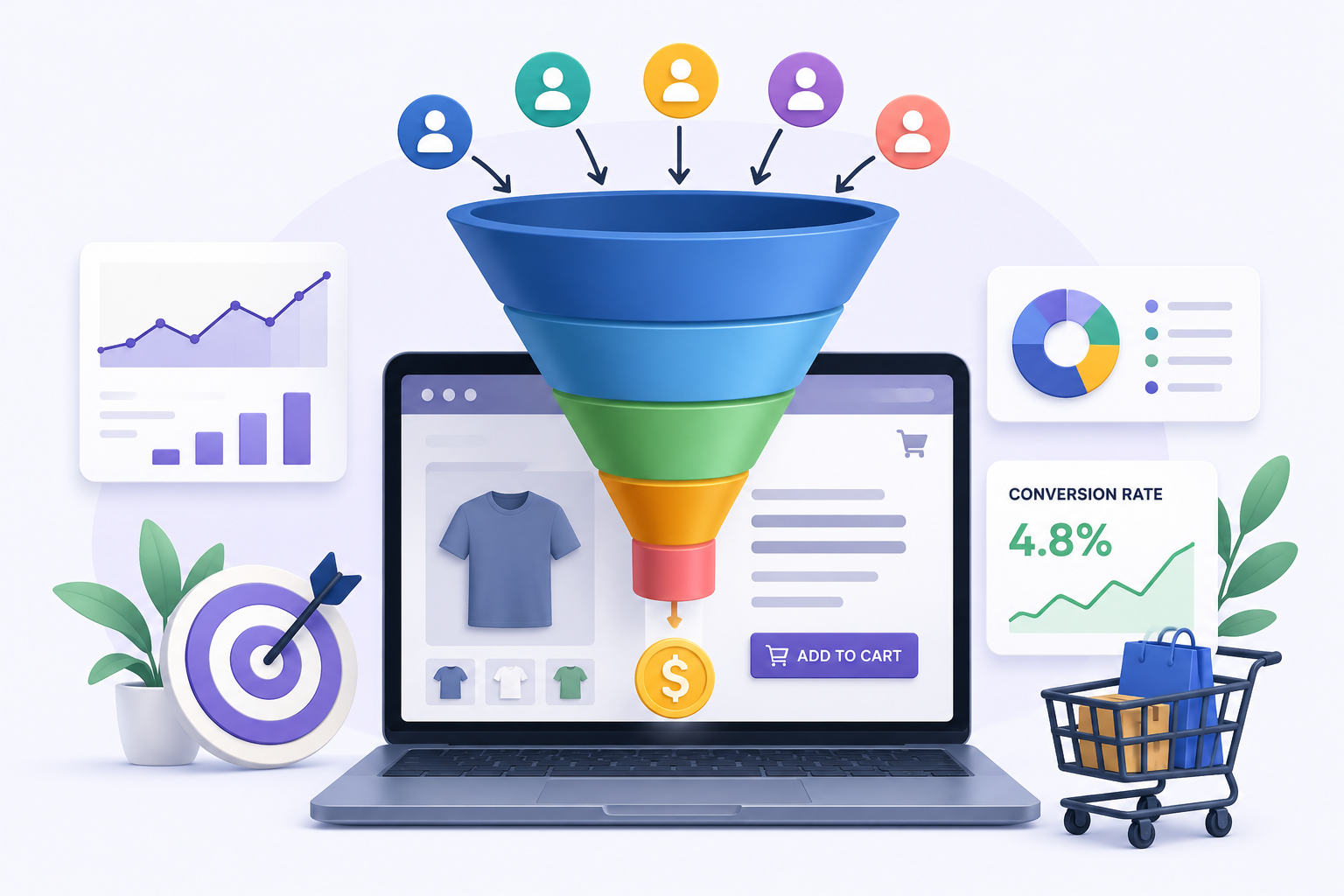
Conversion Rate Optimization (CRO) is the systematic process of improving the percentage of website visitors who complete a desired action – such as making a purchase, signing up for a newsletter, or requesting a demo – through testing, analysis, and refinement.
What Counts as a Conversion?
In marketing, a “conversion” depends on your business model:
- eCommerce: Purchase completion (most common)
- SaaS: Free trial signup, demo request, paid plan activation
- Lead generation: Form submission (contact, quote request, consultation booking)
- Content/Community: Email signup, account creation, course enrollment
Why CRO Matters More Than Traffic Growth
Every marketer wants more traffic. But traffic is only half the equation. A site that attracts 10,000 monthly visitors and converts 2% (200 sales) generates far less revenue than a site with 5,000 visitors converting at 4% (also 200 sales) while spending half as much on ads.
In 2026, as advertising costs climb and platform algorithms tighten, CRO is the profit lever. Marketers who understand the psychology behind consumer purchasing decisions gain a compounding edge – because optimizing for how people actually decide to buy is far more durable than chasing the next traffic spike. A 1% improvement in conversion rate compounds into 12%+ annual revenue growth.
What CRO is NOT
CRO is not dark patterns, trick copy, or shady UX designed to deceive users into converting. Ethical CRO removes friction while building trust – faster checkout without sacrificing security, clearer CTAs that reflect real value, product recommendations that customers actually want.
How to Calculate Your Conversion Rate
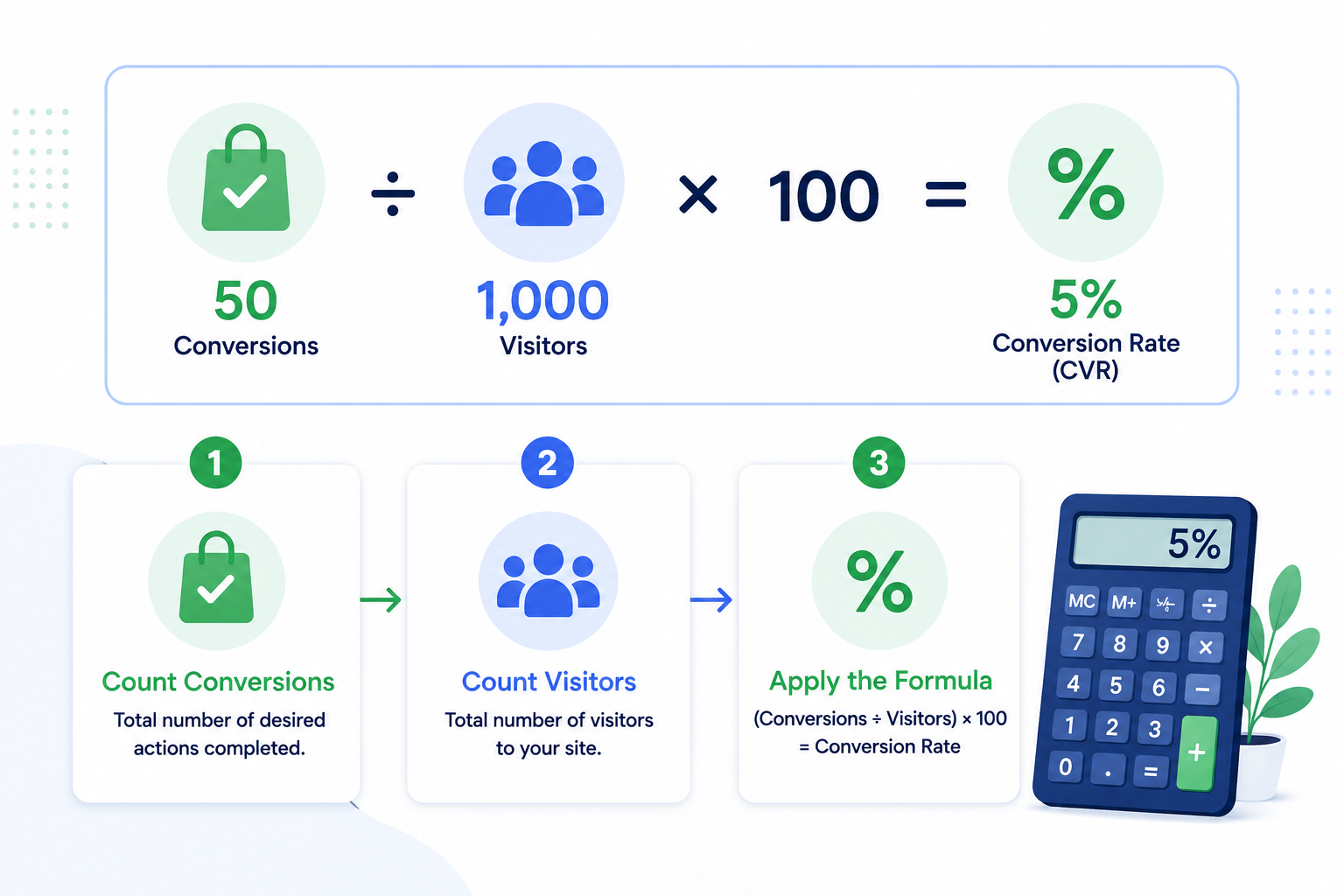
The Conversion Rate Formula
The math is simple:
(Conversions ÷ Total Visitors) × 100 = Conversion Rate (%)
Example:
- 1,000 visitors in a month
- 50 make a purchase
- (50 ÷ 1,000) × 100 = 5% conversion rate
Calculation Methods
- By Sessions: Track completed actions per unique session (most common)
- By Unique Visitors: Actions per unique IP/user (accounts for multi-session journeys)
- By Leads: For B2B, track qualified leads delivered to sales per visitor
Industry Benchmarks (2026)
| Vertical | Avg Conversion Rate | Notes |
| Food & Beverage | 5.8% | High impulse |
| Seasonal Beauty & Personal Care | 4.2% | Review dependency |
| Fashion & Apparel | 2.9% | browsing-to-buy |
| Furniture & Home Decor | 1.3% | Longer consideration cycle |
| Jewelry & Luxury | 0.9% | Premium positioning |
| SaaS (Free Trial) | 3-8% | Depends on lead quality |
| B2B (Lead Gen) | 2-5% | Depends on qualification threshold |
Note for WooCommerce Store Owners: Find your conversion rate in Google Analytics → Conversions → E-commerce Purchase Conversion Rate (GA4) or Transactions/Sessions (Universal Analytics).
How to Prioritize CRO Efforts – The PIE Framework
Not all CRO opportunities are created equal. A/B testing every element on your site wastes time. The PIE Framework helps you focus on high-impact changes:
- Potential: How much traffic does this element receive? (High-traffic areas = high potential)
- Importance: How much friction does it create for conversions? (Checkout > PDP > blog)
- Ease: How simple is the test to implement and run? (Copy tests vs. major redesigns)
Prioritization Scoring Table
| Initiative | Traffic (P) | Friction (I) | Effort (E) | Score | Priority |
|---|---|---|---|---|---|
| Simplify checkout fields | 8/10 | 9/10 | 3/10 | 216 | Critical |
| Product page upsells | 7/10 | 6/10 | 4/10 | 168 | High |
| Homepage hero copy test | 10/10 | 4/10 | 7/10 | 280 | High |
| Footer link colors | 6/10 | 2/10 | 9/10 | 108 | Medium |
| Blog sidebar redesign | 3/10 | 1/10 | 5/10 | 15 | Low |
Key Insight: Fix checkout friction first. It impacts every potential customer; even small improvements compound across thousands of daily transactions.
eCommerce Conversion Rate Optimization (for WooCommerce and Shopify stores)
Product Pages
High-res multi-angle imagery is non-negotiable. 60%+ of shoppers depend on product images. Use:
- Multiple angles (360° view)
- Lifestyle shots (product in context)
- Zoom-on-hover functionality
Product descriptions balance technical specs with customer benefits:
- First line: answer “Why should I buy this?”
- Bullet points: key features + benefits
- Size/fit guidance: address common objections
- Variant visualization: swatches vs. dropdowns matter. Swatches reduce friction—customers see options instantly without clicking.
Recommended tool: Variation Swatches for WooCommerce – attributes display as color/image swatches, reducing clicks to conversion.
Quick View modals cut friction—shoppers see product details without leaving category pages.
Recommended tool: WooCommerce Quick View – inline product preview modal.
Checkout Optimization
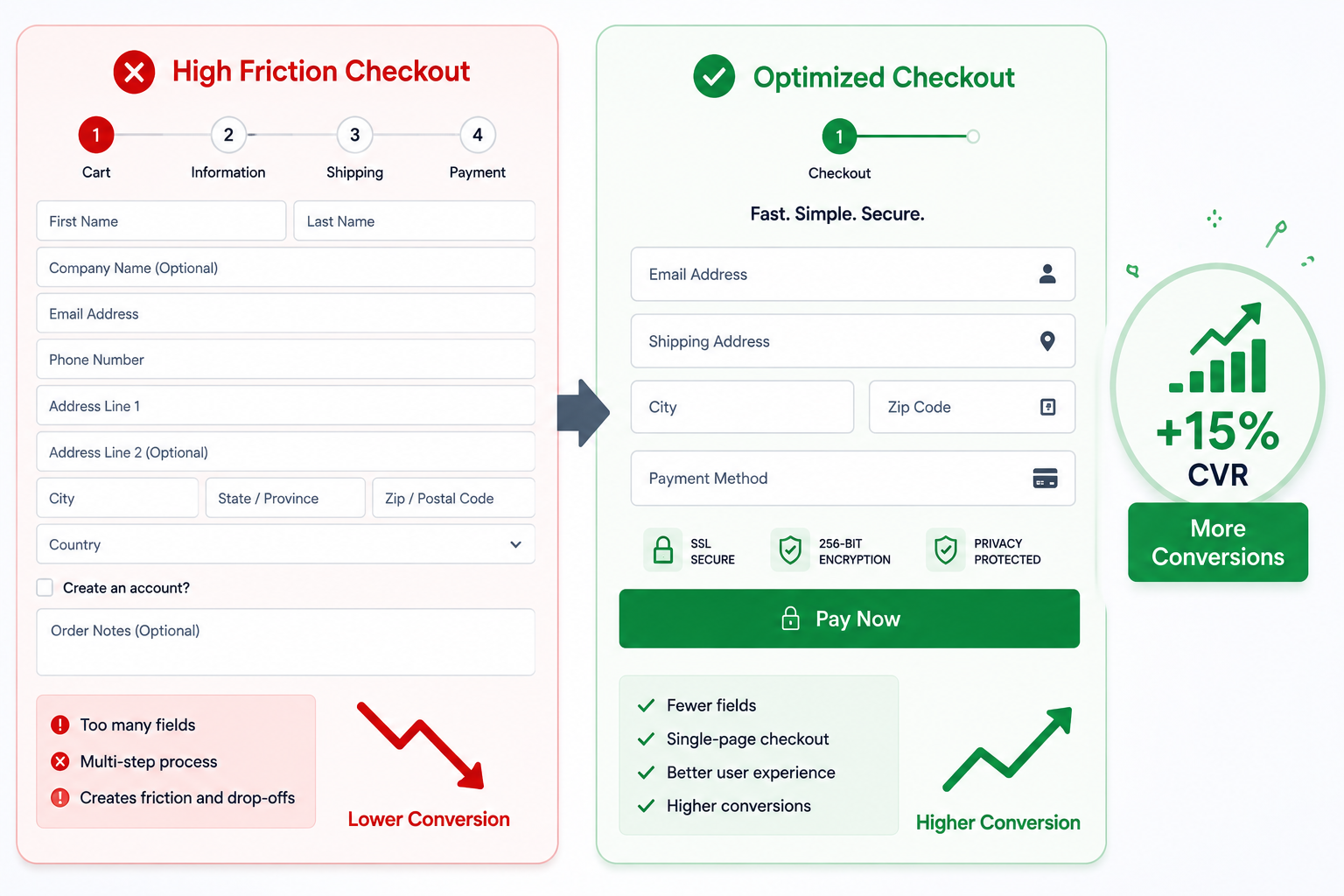
Friction is the enemy. Every extra field, page, or decision drops conversion 5-15%.
- Field simplification: ask only for essential info (WooCommerce Checkout Field Editor lets you reorder, hide, or require fields)
- Single-page checkout: no multi-step process
- Guest checkout: don’t force account creation
- Auto-fill: use address lookup APIs to populate shipping/billing in one click
- Trust signals: security badges, return policy, guaranteed safe payment
Pricing & Promotions
Dynamic pricing rules based on user segment, cart size, or urgency can boost conversion:
- Higher-tier discounts for bulk purchases
- VIP/returning customer discounts
- Time-limited flash sale pricing
Product badges (Sale, Best Seller, Limited Stock) trigger scarcity/urgency psychology – but only if real.
Recommended tools:
- WooCommerce Dynamic Pricing with Discount Rules Pro – rule-based pricing automation
- WooCommerce Product Labels – custom badges for sale/trending/limited stock
Landing Pages
Above-the-fold value prop: visitors have <3 seconds to grasp why they should stay.
- Clear headline: answer “What do I get?”
- Subheadline: specific benefit or proof
- CTA buttons: single primary action (not competing buttons)
- Mobile responsiveness: 60%+ of eCommerce traffic is mobile
Shopify CRO
Shopify merchants have unique advantages and constraints versus WooCommerce.
Shopify Checkout Optimization:
- Built-in checkout is locked but highly optimized (Shopify’s own data shows 1-step checkout lifts CVR 3-5%)
- Checkout extensions (via Shopify App Store) can add custom fields, post-purchase flows, or payment options without redesigning checkout
- Shopify’s native A/B testing (Settings → Checkout) lets you test checkout settings (payment icons, contact form requirement) directly
Shopify Conversion Apps:
- Shoppable videos for Shopify: embed product carousels in video content (e.g., YouTube, Instagram) — Shopeo leads this category
- Shopify Ai Chatbot: real-time product recommendations and objection handling — CartEasy by Acowebs
- Shopify Product labels: urgency badges (Low Stock, Best Seller, Sale) – Labeler
- Social proof: review aggregators (Trustpilot, Yotpo) and user-generated content galleries
Shopify-specific A/B testing: Use Shopify’s built-in test function for payment method placement, contact requirement fields, or shipping method presentation.
B2B Conversion Rate Optimization
B2B conversion funnels operate differently than eCommerce because buyers are risk-averse, multiple stakeholders are involved, and sales cycles span weeks or months.
Key B2B conversion levers:
- Demo CTAs: “See it in action” buttons on key pages (pricing, features, use-case pages) – high friction to request, but qualified leads
- Case studies: social proof from similar-industry customers reduces perceived risk
- Transparent pricing: show at least price ranges; lack of visible pricing kills 40%+ of B2B leads immediately
- Lead scoring + qualification: Not all leads are equal. B2B CRO includes scoring logic to surface sales-ready prospects faster
- Multiple proof formats: whitepapers, webinars, free trials reduce friction vs. demo-only CTAs
Messaging difference: B2B copy emphasizes ROI, security, integration, and scalability. eCommerce copy emphasizes desire, social proof, and urgency.
Conversion Rate Optimization Strategy – 8 Tactics That Work
1. A/B Test Your CTAs
What to test:
- Copy (“Add to Cart” vs. “Secure Your Order” vs. “Buy Now”)
- Color (high contrast typically wins, but test your brand)
- Placement (above fold, sticky header, bottom of PDP)
- Size and whitespace (bigger CTAs = higher clickthrough)
Rule: Never rely on opinion. Let data decide.
2. Reduce Checkout Friction
Every extra field, validation error, or unexpected charge loses 2-5% of transactions.
- Minimize form fields (ask only for essentials)
- Use autofill (address lookup, country codes)
- Confirm expected shipping cost before payment
- Show progress bar (Step 1/3 of checkout)
- Offer multiple payment methods (credit card, PayPal, Apple Pay, Google Pay)
3. Use Social Proof
Trust is a conversion prerequisite.
- Star ratings + review count (on product pages and listing pages)
- Recent purchase notifications (“John in California just bought this”)
- Customer testimonials with photos/video
- Trust badges (SSL certificate, BBB, industry certification)
- User counts (“Trusted by 10,000+ merchants”)
4. Personalize Product Discovery
The era of one-size-fits-all product discovery is over.
- Product recommendations: “Frequently bought together”, “Customers also viewed”
- Upsells: suggest higher-tier variants based on cart value
- Cross-sells: recommend complementary products
- AI personalization: show different products to first-time vs. returning visitors
5. Improve Page Speed
Every 1-second delay costs 7% of conversions. (And Google now uses Core Web Vitals as a ranking factor, so speed = rankings = traffic.)
- Compress images (use modern formats: WebP, AVIF)
- Minify CSS/JavaScript
- Lazy-load offscreen images and videos
- Use a CDN (content delivery network) to serve from geographically closer servers
- Reduce unused code and third-party scripts (tag managers, chat widgets, analytics)
WooCommerce stores: Use caching plugins (W3 Total Cache, WP Super Cache) and image optimization (Smush, ShortPixel).
6. Leverage Live Chat / AI Chat
Remove objection barriers in real time.
- Live chat converts 2-4% higher when proactively offered (“Can we help?” at 30 seconds)
- AI chatbots (CartEasy) answer FAQs 24/7 without human cost
- Chat can also recommend products, offer discounts, or guide users toward CTAs
- Rule: Don’t interrupt (avoid chat popups < 10 seconds). Offer, don’t force.
7. Deploy Urgency & Scarcity Triggers (Ethically)
Scarcity and urgency are psychological hot buttons—but only work if authentic.
- Stock counters: “Only 3 left in stock” (real, based on inventory)
- Countdown timers: “Sale ends in 2:14:38” (for actual flash sales, not fake countdowns)
- Limited availability: “Available for 3 more days” (be honest)
Gotcha: Fake urgency damages trust long-term. Use only if genuine.
8. Optimize for Mobile
Mobile is 60%+ of eCommerce traffic. If your mobile experience lags, you’re leaving half your revenue on the table.
- Thumb-friendly buttons (minimum 48×48 pixels)
- Single-column layout (no side-by-side content)
- Mobile-first checkout (fewer fields on small screens)
- Fast image loading (mobile users on slower connections)
- Readable text (minimum 14px font, good contrast)
Conversion Rate Optimisation Tools
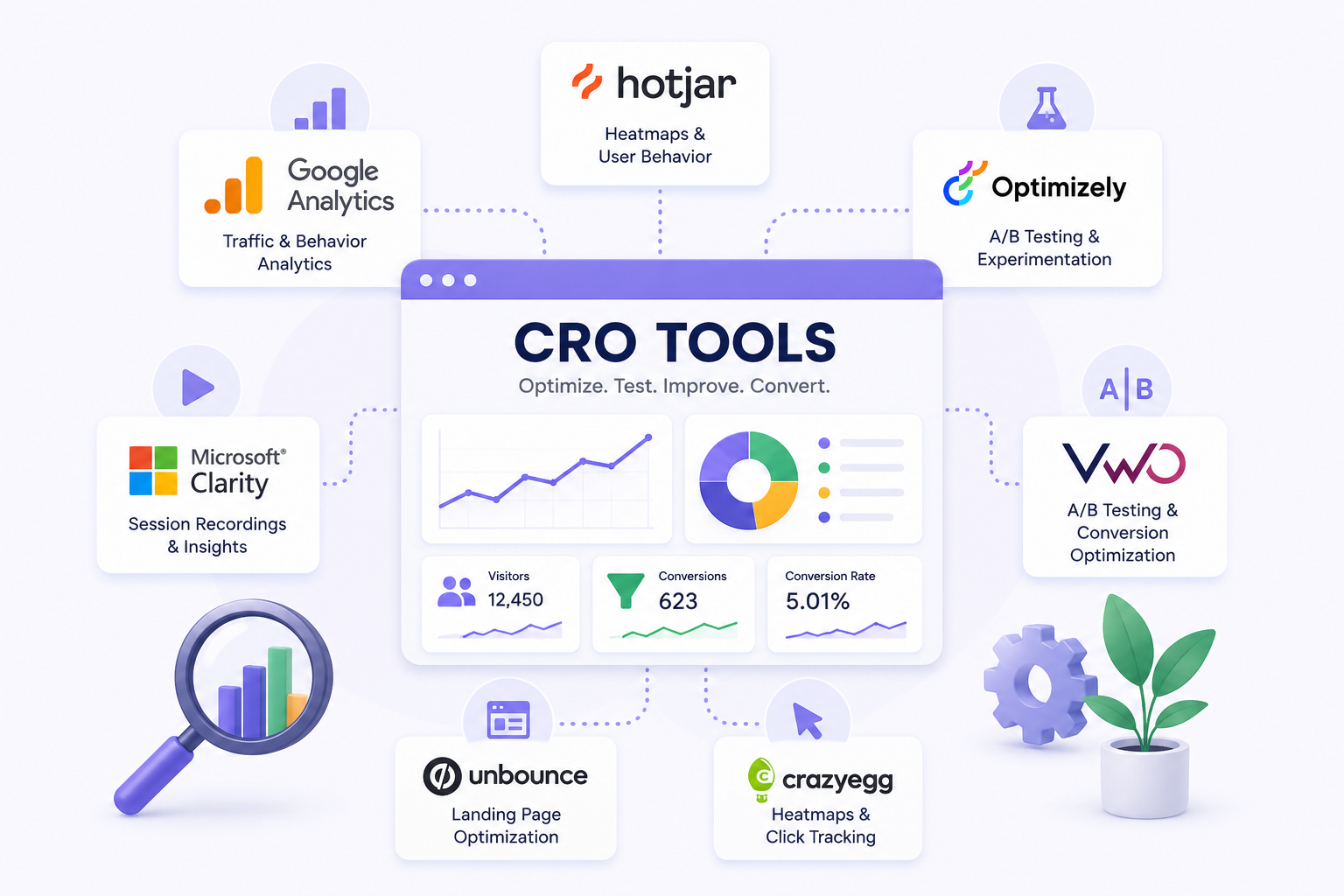
Google Analytics 4 (Free)
Purpose: Baseline conversion tracking and A/B test analytics.
- Set up conversion events (purchase, signup, demo request)
- Segment traffic by device, source, user behavior
- Run experiments directly in GA4 (up to 25% of traffic; typically 2-4 week runtime)
Hotjar (Free / Paid)
Purpose: Heatmaps, session recordings, and user feedback.
- See where users click, scroll, and rage-click
- Record user sessions to watch how real people navigate
- Identify friction points before A/B testing
VWO (Paid, Free Trial)
Purpose: A/B testing and multivariate testing at scale.
- Test multiple page variations simultaneously
- Visual editor (no code required)
- Statistical significance calculator built-in
Optimizely (Paid)
Purpose: Enterprise-grade experimentation platform.
- Supports complex experiments (multivariate, sequential testing)
- Integration with CDP (customer data platform) for advanced personalization
- Ideal for high-traffic sites where statistical power matters
CartEasy by Acowebs (Freemium)
Purpose: AI shopping assistant for Shopify.
- Product recommendations in real time
- Upsells, cross-sells, and abandoned cart recovery
- Chat-based customer support automation
Why Conversion Rate Optimization Matters in 2026
The Cost of Paid Traffic is Rising
- Google Ads CPC (cost per click) has climbed 10-15% annually for 5 years
- Social media CPM (cost per thousand impressions) is up 20%+ year-over-year
- Email and organic search (the low-cost channels) face growing saturation
CRO changes the equation: 1% CVR improvement = same revenue at half the ad spend.
Increased Competition
eCommerce has 24 million active stores (Shopify alone hosts 2+ million). Standing out on traffic alone is impossible. Conversion becomes the differentiator.
AI-Driven Customer Expectations
Customers now expect personalization. They know their data shapes their experience—and they reward sites that use it ethically. AI-powered product recommendations, dynamic pricing, and chatbots are no longer “nice to have” they’re baseline.
Mobile-First, Multi-Channel Behavior
73% of eCommerce traffic is mobile. Shoppers research on mobile, buy on desktop, and vice versa. Omnichannel CRO (ensuring consistency across web, mobile, social, email, in-app) is essential.
Benefits of CRO
- More sales from existing traffic → Higher profit margins
- Better customer experience → Higher retention and repeat purchases
- Lower CAC (customer acquisition cost) → More budget for growth
- Competitive moat → Harder for competitors to out-spend you
- Reduced ad spend → Healthier unit economics
Statistics & Trends (2026)
- Industry average CVR (eCommerce): 2-3% (range: 0.5% – 5% depending on vertical)
- Shopify merchant median CVR: ~2.1% (top 10% exceed 5%)
- Mobile CVR vs. Desktop: Mobile lags 10-30% (optimization is asymmetrical)
- Checkout abandonment: 70% globally; average cart value recovered in abandoned carts: $2.7B+ annually
- Power of social proof: Products with 50+ reviews convert 2.5x higher than those with <5 reviews
- Page speed impact: 3-second page delay = 40% increase in bounce rate
2026 Trend: AI-powered testing (auto-run experiments, intelligent statistical analysis) and zero-party data (customers voluntarily share preferences) are reshaping CRO from guesswork to science.
FAQ Section
Q: What does CRO mean in marketing?
A: CRO (Conversion Rate Optimization) is the process of increasing the percentage of website visitors who complete a desired action – like making a purchase, signing up, or requesting a demo-through systematic testing and refinement.
Q: What is a good conversion rate for eCommerce?
A: The average is 2-3%, but “good” depends on your vertical. Fashion averages 2.9%, while food & beverage averages 5.8%. Compare against your industry benchmark and set targets in 0.5% increments. A 1% improvement is a win.
Q: What is the CRO formula?
A: (Conversions ÷ Total Visitors) × 100 = Conversion Rate (%). Example: 50 sales ÷ 1,000 visitors × 100 = 5% CVR.
Q: What are the best CRO tools?
A: Google Analytics 4 (free, baseline), Hotjar (heatmaps, free tier available), VWO or Optimizely (A/B testing), and AI tools like CartEasy (Acowebs) for product recommendations.
Q: How is CRO different from SEO?
A: SEO drives traffic to your site (keyword ranking, organic visibility). CRO improves what users do after arriving (buy, sign up, download). Both are essential; CRO multiplies the value of SEO traffic.
Q: How long does it take to see CRO results?
A: Small wins (copy tests, field reductions) show impact in 1-2 weeks. Major changes (redesigns, checkout overhaul) take 4-12 weeks to gather statistical significance, especially on lower-traffic sites. Rule of thumb: 100-1,000 conversions per test variant.
Q: What is B2B conversion rate optimization?
A: B2B CRO focuses on lead quality and sales readiness, not transaction volume. Key levers: demo CTAs, case studies, transparent pricing, and lead scoring. Sales cycles are longer; optimization targets the buying committee, not an individual.
Conclusion
Conversion Rate Optimization isn’t complex: test, measure, refine. Small friction reductions compound into outsized revenue gains.
In 2026, the eCommerce and SaaS winners aren’t the ones who spend the most on ads—they’re the ones who convert the smartest. A site converting at 4% with modest traffic beats a site at 2% with triple the visitors.
Start here:
- Measure your baseline (set up conversion tracking in Google Analytics)
- Identify your highest-traffic, highest-friction pages (checkout, product pages, landing pages)
- Run one A/B test per month (CTA copy, field count, visual change)
- Iterate based on data
Every 0.5% improvement is a win. Over a year, that’s 6%+ compound growth—without increasing your ad spend.
Acowebs are the developers of Woocommerce Product options which is a optimized, lightweight, and fruitful plugin that is simply the best to add extra product options using its custom form builder easily. WooCommerce custom fields also comes with drag and drop form builder, 22+ field types and custom price formula.
CRO (Conversion Rate Optimization) is the process of increasing the percentage of website visitors who complete a desired action – like making a purchase, signing up, or requesting a demo-through systematic testing and refinement.
The average is 2-3%, but “good” depends on your vertical. Fashion averages 2.9%, while food & beverage averages 5.8%. Compare against your industry benchmark and set targets in 0.5% increments. A 1% improvement is a win.
(Conversions ÷ Total Visitors) × 100 = Conversion Rate (%). Example: 50 sales ÷ 1,000 visitors × 100 = 5% CVR.
Google Analytics 4 (free, baseline), Hotjar (heatmaps, free tier available), VWO or Optimizely (A/B testing), and AI tools like CartEasy (Acowebs) for product recommendations.
SEO drives traffic to your site (keyword ranking, organic visibility). CRO improves what users do after arriving (buy, sign up, download). Both are essential; CRO multiplies the value of SEO traffic.
Small wins (copy tests, field reductions) show impact in 1-2 weeks. Major changes (redesigns, checkout overhaul) take 4-12 weeks to gather statistical significance, especially on lower-traffic sites. Rule of thumb: 100-1,000 conversions per test variant.
B2B CRO focuses on lead quality and sales readiness, not transaction volume. Key levers: demo CTAs, case studies, transparent pricing, and lead scoring. Sales cycles are longer; optimization targets the buying committee, not an individual.