













 Login
Login
 Cart
Cart
Global b2b ecommerce is growing fast. Research and Markets puts the market at $19.34 trillion in 2024 and expects it to more than double to $47.5 trillion by 2030. In simple terms, b2b ecommerce is the buying and selling of goods or services between businesses over the internet a manufacturer selling to a distributor, or a wholesaler taking orders from retailers without a sales rep in the middle.
This guide covers everything you need to plan a wholesale storefront: what b2b ecommerce is, the five business models, the features buyers expect, the platforms available, sales and marketing strategies, the trends shaping 2026, and five practical steps to launch.
What Is B2B Ecommerce?
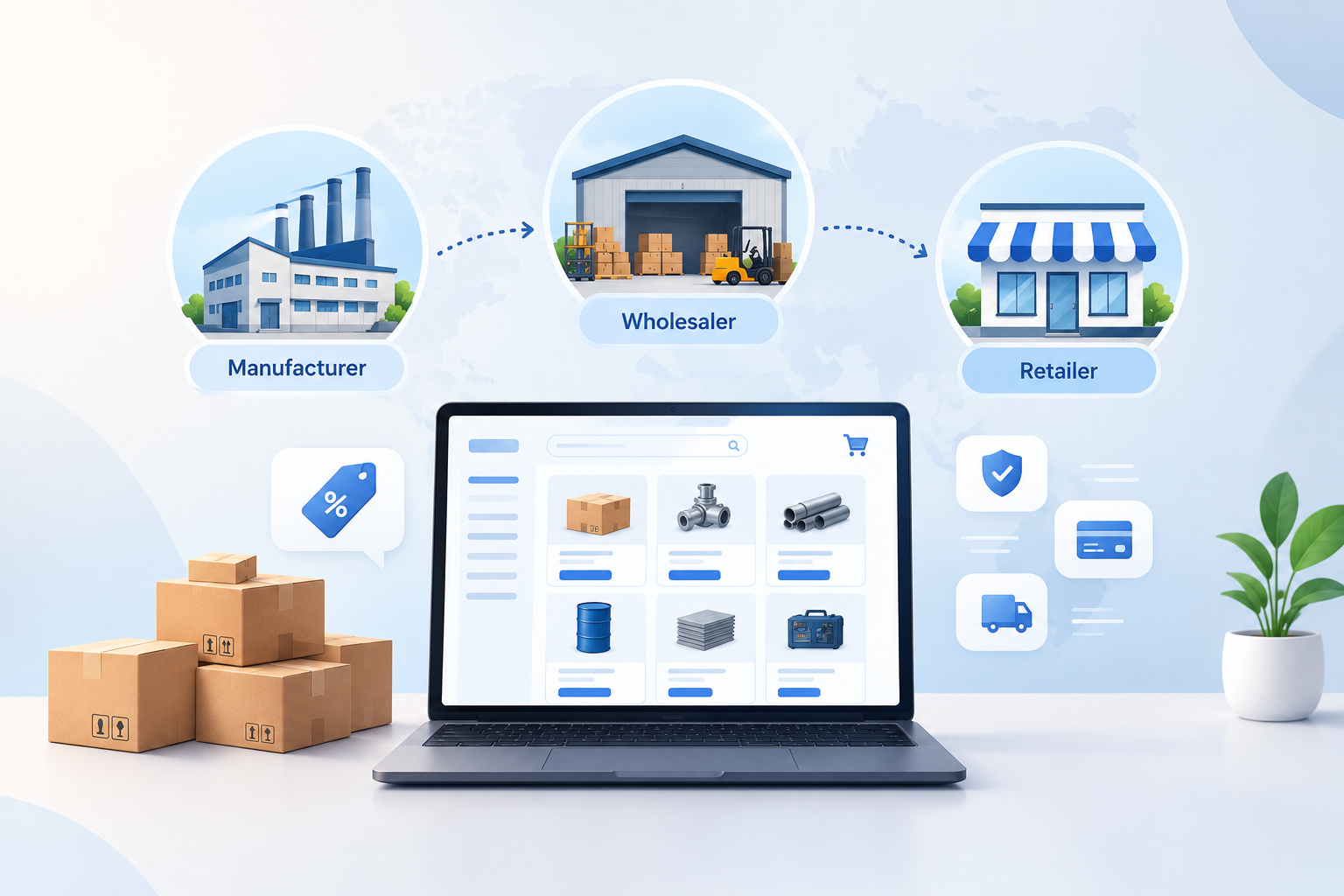
B2B ecommerce is the sale of products or services from one business to another through a digital storefront, marketplace, or portal. The buyer is an organisation, not an individual: a food manufacturer purchasing packaging, a retailer reordering stock from a wholesaler, or a contractor buying fittings in bulk.
Definition box: B2B ecommerce (business-to-business ecommerce) is the online transaction of goods or services between businesses. Instead of quoting over email and phone, the seller runs a store or portal where business buyers browse a catalog, see account-specific pricing, and place orders themselves.
A quick example: a stationery wholesaler sells to 200 independent shops. Before ecommerce, every reorder was a phone call. With a b2b ecommerce store, each shop logs in, sees its own tiered prices, adds cartons to the cart, and checks out with a purchase order number and the wholesaler’s team spends its time on new accounts instead of order entry.
Benefits of B2B Ecommerce
Why do wholesalers and manufacturers invest in online selling? The returns are concrete:
- Lower cost to serve. A self-service order costs a fraction of a rep-handled one no order entry, no quoting back and forth.
- Faster order cycles. Orders placed at 10 pm are processed by the morning; nobody waits for the office to open.
- Fewer manual errors. Digital orders remove misheard SKUs and transposed quantities.
- 24/7 ordering. Buyers in other time zones or working nights can order whenever they need.
- Wider reach. A storefront is open to every customer with an internet connection, not just the accounts a rep can visit.
- Better customer data. Every order, view, and search is recorded, showing you what accounts actually buy.
- More rep time for high-value accounts. Automation handles the routine reorders; salespeople focus on new business and the big accounts.
Takeaway: b2b ecommerce does not replace your sales team it re-deploys them. The store handles the repeatable 80%; the people handle the relationships.
Key Features of a B2B Ecommerce Solution
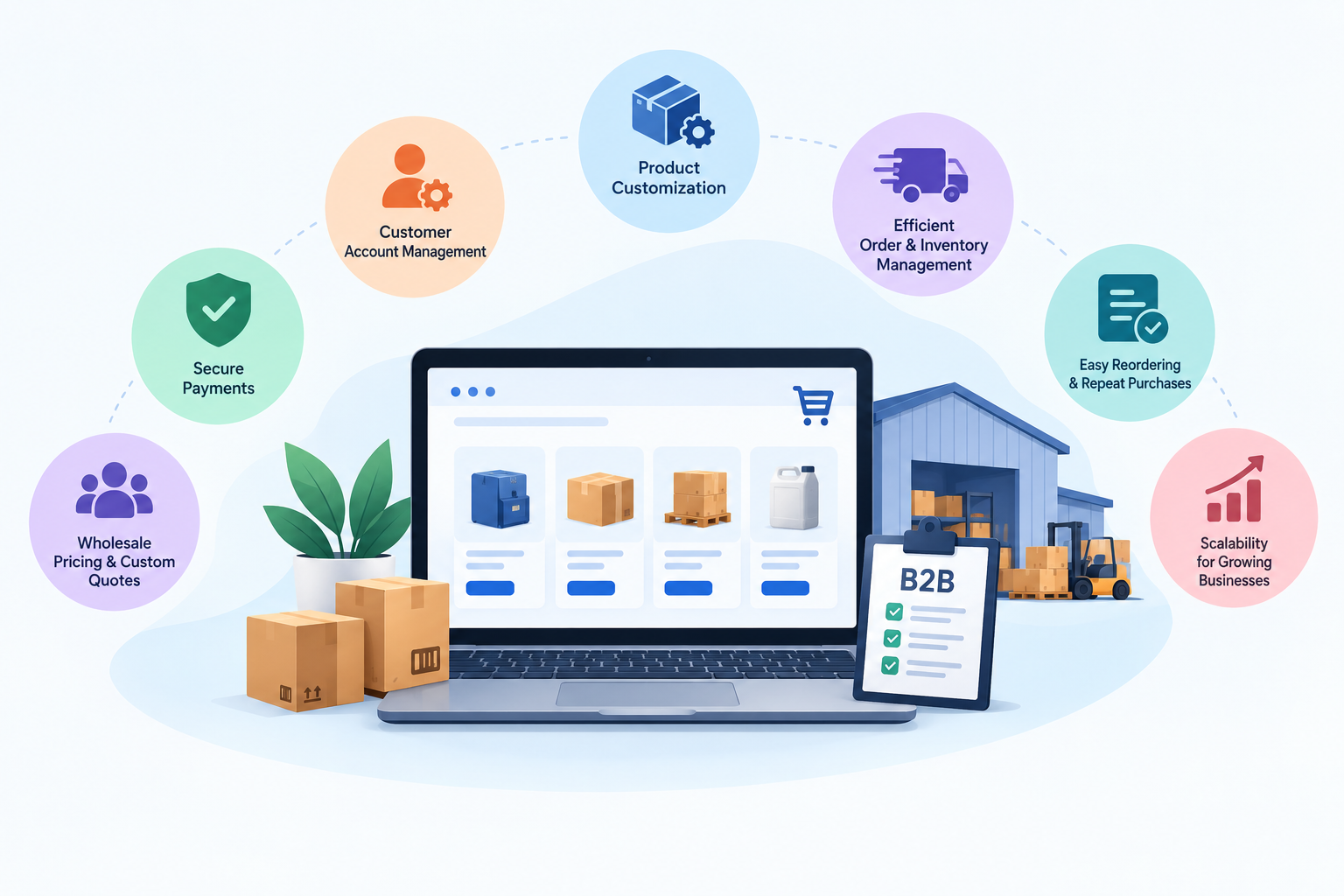
A serious b2b ecommerce solution is not a retail store with a login page. These are the features business buyers expect, with the job each one does:
Custom and Tiered Pricing
Prices can differ by customer, by customer group, or by quantity. A retailer ordering 500 units pays a different rate than one ordering 50. Benefit: you keep negotiated contracts accurate without editing prices by hand. In WooCommerce, a plugin like Dynamic Pricing With Discount Rules Pro applies group and quantity rules automatically.
Bulk Order and Quick Order Forms
Business buyers often order dozens of SKUs at once. Quick order forms let them paste a list of SKUs and quantities or reorder a past order instead of adding items one by one. Benefit: fewer abandoned carts from typing fatigue.
Role-Based or Gated Catalogs
Not every buyer should see every product or price. Roles and permissions control what each account can view, from a full catalog for approved resellers to a restricted range for cash customers. Benefit: protects pricing and channel agreements.
Quotes and RFQs
Large orders rarely start with checkout; they start with a price request. The buyer submits a quote request, the seller responds with a formal quote, and the buyer approves it into an order. Benefit: complex deals happen inside the system instead of in email threads.
Reorder Lists and Saved Carts
Repeat buyers want a one-click path to the order they place every month. Saved carts, wishlists, and “buy it again” lists cut the time per reorder from minutes to seconds. Benefit: higher order frequency and loyalty. A Wishlist plugin doubles as a saved-list tool for logged-in trade accounts.
B2B Checkout: PO Number, Tax ID, Net Payment Terms
B2B checkout captures fields a consumer checkout never asks for: purchase order number, tax ID or VAT number, company name, and delivery notes, and it supports invoicing and net terms. Benefit: orders match the buyer’s accounting process. The Checkout Field Editor and Manager add and validate these fields without code.
Account Management and Approvals
Businesses have multiple buyers a warehouse manager orders, a finance manager approves. Multi-user accounts with roles, order limits, and approval workflows keep purchasing controlled. Benefit: you sell to the whole company, not one employee.
ERP, CRM and Inventory Integrations
The store must talk to the systems the business already runs: inventory, ERP, CRM, and accounting. Real-time stock levels, automatic order sync, and customer history make the store part of operations rather than a separate silo. Benefit: no double entry, no overselling, accurate data everywhere.
The takeaway: every feature on this list removes friction that a phone call used to absorb. The more of them you automate, the cheaper each order becomes to serve.
B2B Ecommerce Examples
Three companies show what good b2b ecommerce looks like at different scales.
Grainger
Grainger is the largest industrial supplier in North America, selling maintenance and safety products to businesses. Its online catalog lists millions of SKUs with account-specific pricing, punch-out integration for procurement systems, and deep inventory visibility. What they do well: the store mirrors how industrial buyers actually procure search, spec, order, reorder. Takeaway: breadth plus accurate, account-aware data wins in industrial b2b.
Amazon Business
Amazon Business applies Amazon’s retail muscle to b2b: business-only pricing, quantity discounts, approval workflows, and procurement integration. Buyers get the familiar Amazon experience with tax exemption handling and business analytics. What they do well: making b2b ordering as easy as consumer ordering. Takeaway: if your buyers already use marketplaces, be where they search.
Alibaba
Alibaba connects manufacturers, especially in Asia, with business buyers worldwide. It handles the discovery layer search, supplier verification, trade assurance while transactions happen through negotiation and payment protection. What they do well: solving the trust problem in cross-border b2b. Takeaway: for new markets, a marketplace presence can be the fastest route to first orders.
Takeaway: the common thread is self-service at scale, accurate data, account-specific pricing, and easy reordering. Your store can copy that pattern at any size.
B2B vs B2C Ecommerce
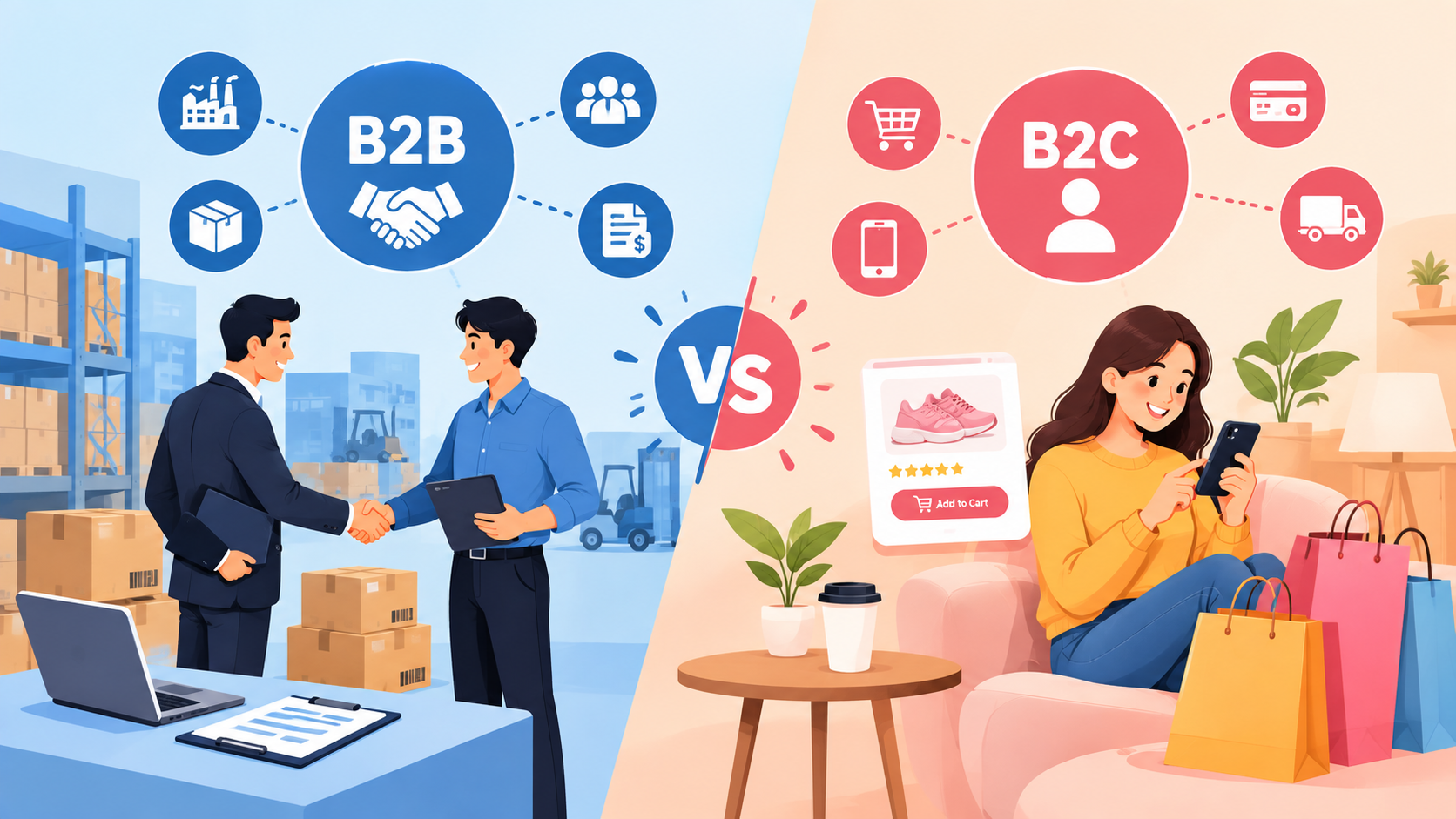
B2B and B2C stores look similar on the surface but behave very differently underneath. This table summarises the main contrasts:
| Aspect | B2B Ecommerce | B2C Ecommerce |
| Buyer | A company or its employees | An individual consumer |
| Order size | Large, bulk quantities, repeat orders | Small, single items |
| Pricing | Contract, tiered, or negotiated per account | One fixed price for everyone |
| Decision cycle | Long; multiple stakeholders and approvals | Short; one person decides |
| Payment terms | Net 30/60, PO numbers, credit limits | Cards, wallets, instant payment |
| Relationship | Ongoing account with a rep and support | Transactional, low loyalty |
The takeaway: B2C is designed to convert a visitor in minutes; B2B is designed to serve an account for years. Features like custom pricing, quotes, and approvals exist because a b2b purchase is a business decision, not an impulse.
Types of B2B Ecommerce Models
Not every b2b business sells the same way. Five models cover most of what you will see online:
Manufacturer to Distributor or Wholesaler
The manufacturer sells directly to businesses that buy in bulk under a contract. Orders are large, pricing is negotiated, and the distributor handles warehousing and resale. Think of a furniture factory supplying a chain of retail showrooms.
Wholesaler or Distributor to Retailer
The wholesaler sits between the manufacturer and the shop. Tiered pricing rewards volume, reorders are the bread and butter, and the retailer expects fast, reliable fulfilment. This is the classic model behind most wholesale portals.
B2B2C: Business to Business to Consumer
One business sells to another business that then sells to consumers. The seller’s product ends up in the buyer’s own catalog a food brand selling to a supermarket chain, for example. The seller often provides white-label packaging, data, and marketing support.
B2B Marketplaces
Marketplaces connect many sellers with many business buyers. Amazon Business and Alibaba are the best-known examples; niche marketplaces serve specific industries such as construction supplies or lab equipment. Sellers gain reach and search traffic; buyers gain comparison and procurement tools.
Hybrid B2B + B2C Stores
Many brands run one storefront serving both audiences: retail prices for the public, logged-in wholesale pricing for trade customers. It saves the cost of a separate site but demands careful catalog rules: wholesale buyers must never see retail prices and vice versa. WooCommerce handles this well with customer-group pricing plugins.
Takeaway: choose the model that matches how your customers already buy, then design the store around it. Most wholesalers start with model two and grow into hybrid or marketplace selling.
B2B Ecommerce Trends to Watch in 2026
These are the shifts reshaping how b2b companies sell online this year. Each one is a decision you can make now rather than a distant prediction.
Self-Service as the Default Buying Mode
McKinsey’s 2024 B2B Pulse Survey found that 39% of business buyers are comfortable placing self-service orders worth over $500,000, up from 28% two years earlier, and 73% will happily spend $50,000 or more online. Buyers do not want a sales call to place a repeat order; they want the store to be faster than the phone. Invest in self-service checkout and your own team stops being the bottleneck.
AI-Assisted and Agentic Buying
AI agents can now research products, compare offers, and even complete purchases on a buyer’s behalf. Stores that publish clean product data, structured specs, and stable pricing get chosen by these agents; stores with messy catalogs get skipped. This is the fastest-moving trend in ecommerce right now we cover the mechanics in our guide to agentic commerce.
Marketplace Growth
Business buyers increasingly start on marketplaces rather than supplier websites. Amazon Business and industry-specific marketplaces keep growing because they bundle search, comparison, and procurement tools in one place. A marketplace presence works alongside your own store rather than instead of it.
ERP-Connected Commerce
The store is becoming the front door of the ERP. Orders, inventory, invoices, and customer credit sync automatically between storefront and back office, so a price change in the ERP is live on the store within minutes. Disconnected stores look broken to buyers who expect real-time stock.
Younger, Multi-Stakeholder Buyers
Millennial and Gen Z buyers now make up the majority of b2b purchasing committees, and they expect a B2C-grade experience. A Forrester survey commissioned in 2024 found 73% of buyers expect the same convenient online experience they get in consumer shopping real-time stock, one-click reorders, and easy account self-service.
Flexible Payment Terms
Net 30 and net 60 remain standard, but more sellers offer card payments, automated invoicing, and staged payments at checkout. Payment flexibility is now a competitive lever, not an afterthought.
Mobile Ordering
Buyers place orders from warehouses, trade shows, and shop floors. A store that is unusable on a phone loses those orders quick order forms and reorder buttons matter most on small screens.
Stats call out the size of the opportunity
- Global b2b ecommerce market: $19.34 trillion (2024) → $47.5 trillion (2030) Research and Markets
- US site-based b2b sales: $2.3 trillion in 2024, +10.5% EMARKETER, on pace to top $3 trillion by 2028
- 39% of buyers are comfortable with self-service orders over $500,000 (up from 28%) McKinsey B2B Pulse Survey 2024
- 73% of buyers expect a B2C-grade online experience Forrester-commissioned survey, 2024
- 7 in 10 buyers prefer ordering online over phone or email
Takeaway: every trend points in the same direction: buyers want the store to do more, faster, without asking permission. Build for self-service and clean data now.
B2B Ecommerce Marketing Strategies
Business buyers research before they buy, and the research happens online long before a sales call. B2B ecommerce marketing is about being found in that research window and nurturing accounts through a long cycle.
SEO for B2B Stores
Rank for what buyers actually search: product terms, category terms, and industry problem phrases. A store selling commercial kitchen equipment should rank for “commercial ice maker” and “restaurant equipment supplier,” not just its brand name. Product pages, category pages, and simple buying guides are the workhorses.
Content Marketing for Long Buying Cycles
A b2b decision can take months and involve several stakeholders. Content that educates specification guides, comparison posts, industry how-tos keeps your brand in front of the committee while they deliberate. Publish what your customers ask your sales team in every call.
Segmented Email Campaigns
Segment by account type, order history, and stage: new accounts get onboarding, dormant accounts get win-back offers, big buyers get VIP pricing notices. B2B email works because each message can be tied to a specific commercial relationship, not a generic blast.
LinkedIn and Paid Search
LinkedIn reaches the people who sign b2b deals; paid search captures buyers mid-research on high-intent terms. Keep campaigns narrow to a handful of product terms and buyer titles rather than broad brand advertising.
Retargeting Campaigns
B2B visitors rarely buy on the first visit. Retarget the product pages and quote forms they engaged with, and follow up with the account’s other stakeholders. Frequency caps matter; nobody in procurement wants to be chased weekly.
Marketplaces and Partnerships
Selling on Amazon Business or a niche marketplace puts your catalog where buyers already search, and partnerships with complementary suppliers, trade associations, or industry publications bring referral traffic that converts well.
AI-Driven Personalization
Recommendations, dynamic pricing, and search tuned by AI make the store feel built for each account. Personalization is now a baseline expectation for b2b buyers, not a luxury.
Takeaway: b2b marketing is a long-game funnel: attract in the research phase, nurture through the decision, and let the store convert the order.
Common B2B Ecommerce Challenges and Myths
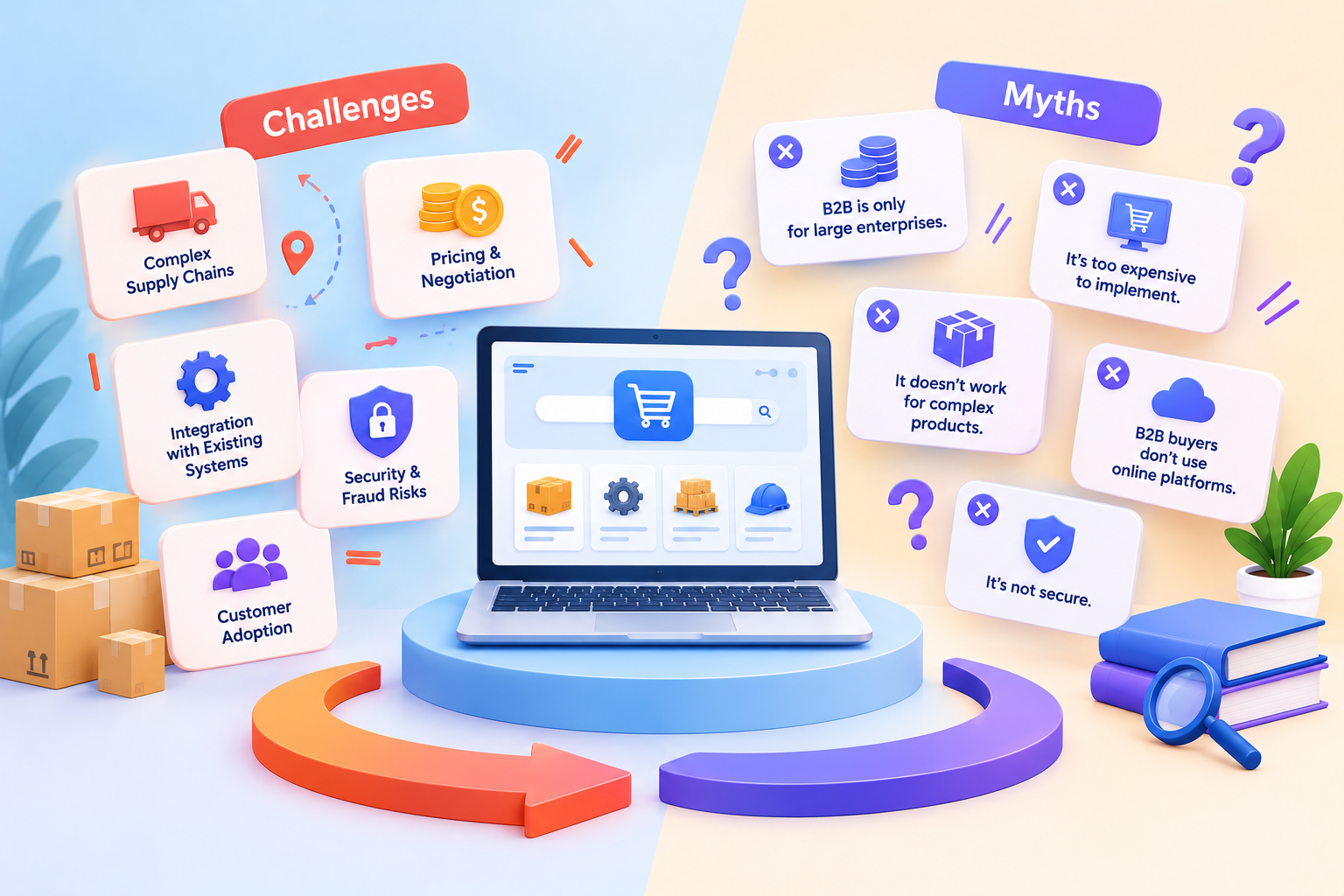
B2B online selling has real obstacles, and just as many outdated assumptions. Here is how the two compare.
Challenges
- Complex pricing. Contracts, tiers, and customer-specific rates are hard to represent in a standard store. The fix: a pricing rules engine that applies the right price by group and quantity automatically.
- Channel conflict. Selling online can undercut your own distributors. The fix: gated catalogs, minimum order values, and account-based pricing that keep channels distinct.
- Legacy systems. Old ERP and inventory systems were never built for real-time storefronts. The fix: integration middleware or plugins that sync orders and stock without replacing the legacy system.
- Buyer trust. Business buyers need to know an online order will be honoured exactly as quoted. The fix: transparent terms, accurate stock, and order confirmation workflows.
Myths
- “Buyers won’t order online.” They already do: 7 in 10 prefer it, and the share of self-service spending keeps climbing.
- “Relationships don’t matter online.” The store strengthens relationships — reps get more time for high-value accounts, and self-service removes friction that used to annoy good customers.
- “Large orders can’t go through ecommerce.” Quote-to-order flows handle six-figure orders every day; the store simply captures what the rep would have written down.
Takeaway: the challenges are integration problems, and the myths are mostly outdated. Both are solvable with the right platform choices.
B2B Ecommerce Platforms and Software
Choosing where to build your store is the biggest decision in the project. The b2b ecommerce software market splits into four platform types.
Types of B2B Ecommerce Platforms
- SaaS platforms (Shopify, BigCommerce): hosted, fast to launch, monthly fee, limited customisation.
- Open-source platforms (WooCommerce, Magento Open Source): full control, no licence fee, you handle hosting and maintenance.
- Headless or composable commerce: the storefront and backend are separate, so teams build custom shopping experiences on APIs. Suits large organisations with in-house developers.
- Marketplaces: you sell on someone else’s platform (Amazon Business, Alibaba) in exchange for fees and rules.
How to Choose B2B Ecommerce Software
Work through this checklist before comparing vendors:
- Pricing flexibility can it do customer groups, tiers, and negotiated prices without custom code?
- Integrations does it connect to your ERP, inventory, accounting, and CRM?
- Scalability will it hold up at 10x your current order volume?
- Total cost: licence, transaction fees, integrations, hosting, and maintenance, not just the sticker price.
- Security and compliance: data protection, payment security, and buyer privacy.
- Support who answers when the checkout breaks at month-end?
Making WooCommerce and Shopify B2B-Ready
Neither platform is b2b “out of the box”; both are excellent foundations that need the right extensions. With WooCommerce, you combine plugins: Dynamic Pricing With Discount Rules Pro for tiers and group pricing, Custom Product Addons for quote-style product options, Quick View for fast SKU checks, and a Wishlist for saved reorder lists. The same needs on Shopify are met by apps from the Shopify App Store.
Takeaway: start with the platform you already run. If you are on WooCommerce or Shopify today, making your existing store B2B-ready is faster and cheaper than migrating to an enterprise suite.
Popular B2B Ecommerce Platforms Compared
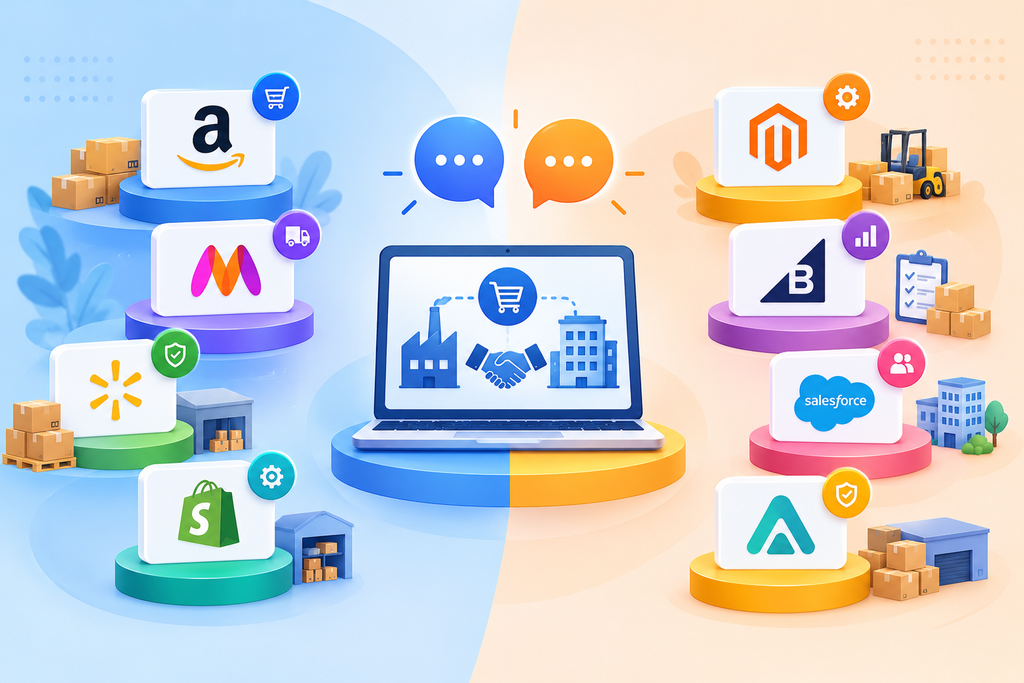
| Platform | Best for | Native B2B depth | Extensibility | Business size |
| Shopify | Brands adding wholesale to an existing DTC store | Good Shopify B2B adds companies, price lists, draft orders | Large app marketplace; custom apps via API | Small to mid |
| WooCommerce | WordPress stores and SMB wholesalers | Good via plugins for pricing, quotes, and account roles | Very high open source, full code access | Small to mid, scalable up |
| BigCommerce | Mid-market retailers | Strong customer groups, price lists, quote management | Good APIs and apps | Mid |
| Adobe Commerce | Enterprise | Strong company accounts, negotiable quotes, shared catalogs | Very high open source core | Mid to large |
| Salesforce Commerce Cloud | Enterprise with heavy CRM use | Strong account and pricing tools | High, via Salesforce ecosystem | Large |
| OroCommerce | Wholesale and manufacturing | Purpose-built multi-organisation, complex pricing, RFQs | High | Mid to large |
Conclusion
B2B ecommerce is no longer an optional channel; it is where business buyers expect to shop. The market is measured in trillions, self-service spending keeps rising, and buyers increasingly judge suppliers by the quality of their online experience. The practical path is clear: pick the model that matches your customers, choose a platform you already understand, add the b2b features buyers expect tiered pricing, quick ordering, custom checkout, saved lists and launch with your best accounts.
If you run a WooCommerce store, the fastest way to make it B2B-ready is with the right plugins. Explore the Dynamic Pricing With Discount Rules Pro, Checkout Field Editor and Manager, Wishlist, Quick View, and Custom Product Addons to see how they turn a retail storefront into a wholesale channel.
Acowebs are the developers of WooCommerce Dynamic Pricing the best way to add discounts based on a range of unconditional and considerable criterias to set with a simple user interface which makes your efforts much easier. discount rules for woocommerce also comes with Percentage / Fixed price discounts.
FAQs
B2B ecommerce is the sale of goods or services between businesses through an online store or marketplace. A wholesaler selling to retailers, or a manufacturer selling to distributors, counts as b2b ecommerce when the transaction happens online rather than through a sales rep.
B2B ecommerce sells to companies, not individuals – buyers order in bulk, pricing is often contract-based or tiered, and the decision usually involves several stakeholders and net payment terms (net 30/60). B2C sells to a single consumer who decides quickly, pays by card, and sees one fixed price. In short: B2B is built to serve an account for years; B2C is built to convert a visitor in minutes.
Run any shortlist through six checks: can it handle customer-group and tiered pricing without custom code; does it integrate with your ERP, inventory, accounting, and CRM; will it hold up at 10x your current order volume; what’s the true total cost once licence fees, transaction fees, integrations, and hosting are added up; does it meet your data and payment security requirements; and who do you call when checkout breaks at month-end. Platforms that check all six tend to outlast the ones that just look good in a demo.
Look for custom and tiered pricing, bulk or quick order forms, gated catalogs, quote requests, saved carts and reorder lists, b2b checkout fields (PO number, tax ID, net terms), multi-user accounts with approvals, and ERP or inventory integrations.
Yes. Neither is b2b out of the box, but both become capable wholesale platforms with the right extensions: pricing rules, quick order forms, custom checkout fields, and saved lists. For most small and mid-size wholesalers, they are the fastest and most affordable route.
B2B buyers pay by credit card, wire transfer, or invoice with net terms such as net 30 or net 60, often referencing a purchase order number. Many stores also support staged or automated payments. The mix depends on the buyer’s accounting process and credit standing.
Research and Markets values the global b2b ecommerce market at $19.34 trillion in 2024, on track to $47.5 trillion by 2030. In the US, EMARKETER reports site-based b2b sales reached $2.3 trillion in 2024, up 10.5%, heading past $3 trillion by 2028.
Rank in search for product and category terms, publish content that helps buyers through a long decision cycle, segment email by account behaviour, run LinkedIn and paid search campaigns, retarget engaged visitors, and personalise pricing and recommendations by account.