








 Login
Login
 Cart
Cart
TL;DR: A unique value proposition (UVP) is the one clear promise that tells shoppers why your store beats every alternative. In ecommerce, it usually centers on product benefits, pricing, convenience, customization, quality, experience, or delivery speed. Write it in one sentence, show it on your homepage, and back it with real store functionality, like product customization, quantity pricing, or order automation. Below: the UVP meaning, five examples, the UVP vs USP difference, and a step-by-step plan to build yours.
Every online shopper faces the same problem: too many stores selling similar products. In a few seconds, they decide whether to stay or leave. A unique value proposition is how you tip that decision; it tells a visitor, clearly and instantly, why your store deserves their money. This guide covers what a UVP is, why it matters for ecommerce, how it differs from a USP, and how to write one your store can actually deliver. Five real examples show the promise in action, and the step-by-step plan at the end turns the idea into a sentence you can put on your homepage today.
What Is a UVP (Unique Value Proposition)?
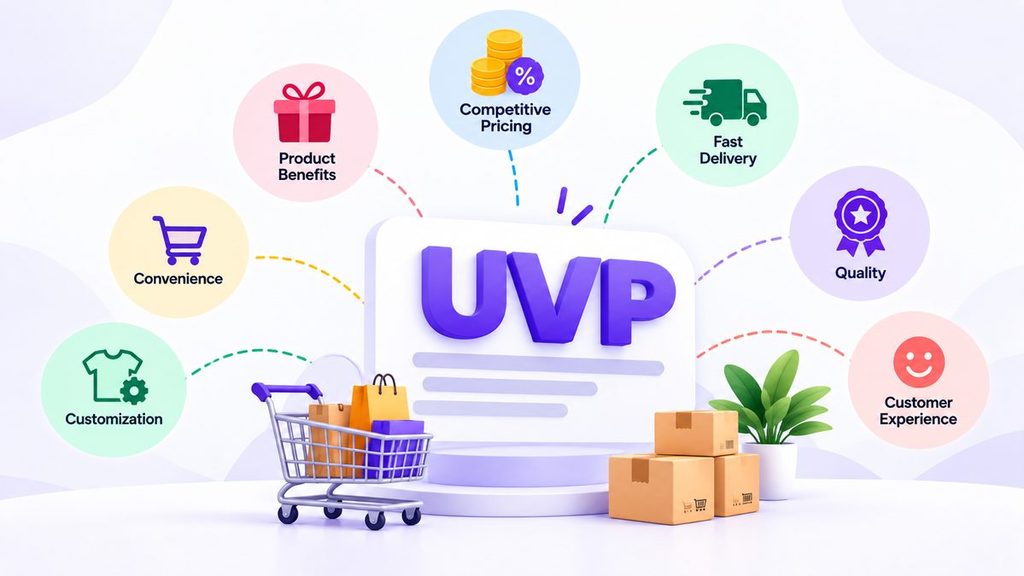
A unique value proposition is a short, clear statement of the value a business promises to deliver. It answers one question: why should a customer buy from you instead of a competitor?
“A business is a value delivery system.”
Michael Lanning and Edward Michaels, 1988.
The UVP meaning in ecommerce is more specific. A general business UVP talks about the brand, its mission, or its market position. An ecommerce UVP focuses on concrete customer value, such as:
- Product benefits
- Competitive pricing
- Convenience
- Product customization
- Quality
- Customer experience
- Fast delivery
Example: “Personalized products delivered quickly at affordable prices.”
This UVP centers on personalization, affordability, and convenience. It gives shoppers three clear reasons to choose the store. That is what a strong UVP does: it removes the guesswork.
For an ecommerce store, the UVP is usually the first thing a new visitor reads. It appears in the hero section of the homepage, in ads, and in product descriptions. If it is vague, shoppers compare you on price alone. If it is specific, they compare you on value.
Why Is a Unique Value Proposition Important for Ecommerce?
A clear UVP matters for three reasons:
- It sets you apart: Competing on price alone is a race to the bottom. A UVP gives customers a non-price reason to pick you.
- It speeds up decisions: Online shoppers do not read everything. A single clear promise tells them in seconds what you offer.
- It improves marketing: Your UVP becomes the message for ads, email, and product pages. Consistent messaging builds trust.
Without a UVP, visitors have to work out your value themselves. Many will leave before they do.
Ecommerce Unique Value Proposition Examples
Here are five practical examples of ecommerce unique value propositions, each built around a different customer benefit.
Example 1: Product Customization
UVP: “Create products that are uniquely yours.”
A store selling personalized products can make customization the heart of its UVP. The more control customers have over product options, colors, sizes, materials, text, and engravings, the more value they feel they are getting. Giving customers more product options creates value in two ways. First, the product fits their exact needs. Second, the shopping experience feels personal. For WooCommerce stores, the WooCommerce Custom Product Addons plugin by Acowebs adds a custom form builder so you can offer extra product options easily. That kind of functionality supports a UVP built around personalized shopping experiences.
Example 2: Bulk Pricing
UVP: “Get better prices when you buy more.”
This UVP targets customers who buy in larger quantities, wholesale buyers, businesses, and bulk households. The value is simple: the more you buy, the less you pay per unit.
Quantity-based or tiered pricing makes this promise real. Instead of a single flat price, the store shows a pricing table: buy 5, pay one price; buy 10, pay a better one. Acowebs’ WooCommerce Dynamic Pricing with Discount Rules lets stores set percentage or fixed discounts on product, cart, and quantity levels, and display pricing tables for quantity discounts. Flexible pricing is exactly the functionality a bulk-pricing UVP needs.
Example 3: Store Automation
UVP: “Spend less time managing orders and more time growing your business.”
Saving time is a strong value proposition, especially for ecommerce owners juggling many tasks. Order and data management eats hours every week. Manual copying between systems causes errors too. Syncing WooCommerce data with Google Sheets can remove that repetitive work. Acowebs’ WooSync – WooCommerce to Google Sheets imports orders and products into Sheets, lets you edit them there, and pushes updates back with validation. Two-way sync means the spreadsheet becomes a control panel for the store. That is a UVP you can demonstrate, not just claim.
Example 4: Convenience
UVP: “Order in minutes. Checkout in seconds.”
Speed and ease are powerful value propositions in ecommerce. Customers abandon carts when checkout is long or confusing. A store that removes friction promises something valuable: their time back. A shorter checkout directly supports this UVP. Tools like Acowebs’ WooCommerce Checkout Field Editor let stores remove unnecessary fields and add custom ones, so the checkout matches the store’s needs.
Example 5: Quality and Trust
UVP: “Premium materials, guaranteed for life.”
Some customers care less about price and more about durability. A quality-focused UVP reassures them that the product will last. A guarantee or warranty turns that promise into proof. This UVP works best when the store can back it up: product photos, material descriptions, reviews, and a clear returns policy. Trust is a value you deliver, not just a word you use.
UVP vs USP: What’s the Difference?
Many people use “UVP” and “USP” as if they are the same. They are related but not identical.
| Aspect | Unique Value Proposition (UVP) | Unique Selling Proposition (USP) |
| Focus | The overall value a customer receives | The specific feature or claim that differentiates a product |
| Scope | Broad, covering price, quality, experience, and delivery | Narrow, focusing on one key selling point |
| Purpose | Explains why customers should choose your business | Highlights what makes your offer unique |
| Key Question | Why should I buy from you? | What makes this offer unique? |
| Example | Personalized products delivered quickly at affordable prices | The only store offering 24-hour engraving |
A USP can be part of a UVP. The USP is the hook; the UVP is the whole reason to choose you.
How to Create a Unique Value Proposition

Follow these five steps to build your own UVP. Each one moves you from a general idea to a sentence customers can act on.
- Know your customer
Write down who they are and the problem they are trying to solve. For ecommerce, be specific about the shopping situation: a busy parent buying gifts, a small business restocking supplies, a hobbyist hunting for rare parts. The clearer the customer, the easier every later step becomes.
- List your benefits
Not features, benefits. “Custom options” is a feature; “a product made exactly for you” is a benefit. “Same-day dispatch” is a feature; “your order arrives before the weekend” is a benefit. Write down every benefit you can think of, then keep the ones that matter most to the customer you described in step one.
- Find your difference
What can you offer that competitors cannot or will not? This is where tools like product customization or quantity pricing become part of your story. If your store lets customers configure products while rivals sell fixed versions, that is a difference you can build a UVP on.
- Write one sentence
Combine the customer, the benefit, and the difference. Aim for under 25 words. A simple pattern works: “For [customer], we deliver [benefit] through [difference].” Keep the words plain; if the sentence needs a second read, it is not ready.
- Test it
Show the sentence to customers. If they can repeat what you sell and why, it works. Ask them what the sentence promises; if they name a different benefit than you intended, revise. A UVP is finished when a stranger can read it and describe your store in one line.
Here is the pattern in action. Weak: “We sell high-quality products at great prices.” Strong: “Personalized products delivered quickly at affordable prices.” Both are true, but the strong version names three specific benefits. That is the difference between a slogan and a unique value proposition.
Best Practices for Ecommerce Value Propositions
- Keep it short
One sentence or a short paragraph. Shoppers scan, not read. If your UVP needs two sentences, use the first for the promise and the second for the proof.
- Put it above the fold
Your homepage hero should state the UVP immediately, ideally in the headline itself. Then repeat it in the first lines of product and category pages, so a shopper landing anywhere in the store still meets your promise within seconds.
- Use specific numbers
“Free shipping over $50” beats “affordable shipping.” “Delivered in 2 days” beats “fast delivery.” Concrete figures are easier to believe and easier to compare against competitors.
- Match the customer’s language
Use the words your customers use, not internal jargon. If your buyers say “engraved gifts” and your site says “customizable merchandise,” rewrite the UVP. It should read like something a customer would tell a friend, not something your marketing team wrote.
- Prove it
Reviews, guarantees, and product demos make the promise believable. A UVP is a claim, and claims need evidence nearby: place the review that mentions your fast shipping next to the shipping promise.
- Reflect your real store
If your UVP promises customization, your store must offer the options. The functionality should support the promise, never contradict it. Shopify’s value proposition guide calls it “the big why” behind your business, and every page should answer it.
- Stay consistent everywhere
Use the same wording on your homepage, product pages, ads, and emails. Changing the message between channels confuses shoppers and weakens the promise.
- Revisit it as your store changes
A UVP is not permanent. When you add a product line, change delivery times, or start targeting a new customer group, check whether the UVP still matches reality. If it no longer describes what your store does best, update it.
- Avoid claims you cannot back
Do not promise “lowest prices anywhere” unless you truly monitor competitors and match them. An unprovable claim erodes trust faster than no claim at all.
Conclusion
A unique value proposition is not a slogan. It is the clearest promise your store makes, and every part of the shopping experience should support it. In a crowded market, one where US ecommerce sales hit $340.2 billion in a single quarter, the stores that win are the ones that give shoppers a specific, believable reason to choose them.
Start with your customer, pick one benefit you can truly deliver, and write it in a single sentence. Then make sure your store can back it up. That is how a unique value proposition goes from a marketing phrase to a competitive advantage.
Acowebs are the developers of the WooCommerce Product Labels which let customers include custom product labels or product badges for WooCommerce products. WooCommerce sales badges plugin provides you with different label styles and customizations for labels. It offers a easy-to-use UI to add labels to the selected products or categories and woocommerce email customizer using which you can easily build and customize WooCommerce emails with a drag-and-drop user interface.-
FAQ
Ecommerce’s unique features include 24/7 availability, no physical location, global reach, personalization at scale, digital payment, and data-driven marketing. These features let stores serve more customers with lower overhead, which is why a clear UVP matters even more online, where shoppers cannot touch the product.
A store stands out by building its UVP around a specific customer benefit: better prices, faster delivery, deeper customization, easier checkout, or stronger guarantees. Then it proves the promise with real functionality, quantity pricing tables, product option builders, order automation, so the claim is visible inside the store itself.
For B2B buyers, the value proposition is usually efficiency and control: bulk pricing, volume discounts, reordering, account management, and clear invoices. Time saved is a core benefit, because B2B purchases are larger and more frequent than consumer ones.
A product value proposition is a statement of the value a single product delivers, and why it solves a customer’s problem better than alternatives. It focuses on product-level benefits, like durability, speed, or fit, rather than the store’s overall promise. The term “value proposition” itself was coined in 1988 by McKinsey consultants, as Wikipedia’s value proposition entry records.